
This post contains affiliate links. As an Amazon Associate I earn from qualifying purchases, at no extra cost to you.
Birthstones by month: January garnet, February amethyst, March aquamarine or bloodstone, April diamond, May emerald, June pearl, moonstone or alexandrite, July ruby, August peridot or spinel, September sapphire, October opal or tourmaline, November topaz or citrine, and December turquoise, tanzanite or zircon. This is the modern list used by US jewelers and the GIA. It was first set in 1912 and has been updated three times since.
As a biologist, I love that birthstones are really a lesson in earth science and biology. One of them is made by a living animal, two are the same mineral in different colors, and one forms deep in the mantle and also falls from space in meteorites. In this guide you will find every month’s stone, its color, what it is made of, how hard it is, and how to care for it.
Birthstone chart by month
| Month | Birthstone | Color |
|---|---|---|
| January | Garnet | Deep red, also orange and green |
| February | Amethyst | Purple |
| March | Aquamarine, bloodstone | Pale blue; dark green with red spots |
| April | Diamond | Colorless |
| May | Emerald | Green |
| June | Pearl, moonstone, alexandrite | White; milky with blue sheen; green to red |
| July | Ruby | Red |
| August | Peridot, spinel | Lime green; red, pink, blue and more |
| September | Sapphire | Blue, also many other colors |
| October | Opal, tourmaline | Play of color; pink and many colors |
| November | Topaz, citrine | Golden yellow to orange |
| December | Turquoise, tanzanite, zircon | Sky blue; violet blue; blue |
Source: the GIA birthstone guide, from the Gemological Institute of America, the nonprofit that created the diamond grading system most jewelers use.
Each birthstone explained
January: garnet
Garnet is not one mineral but a family of silicate minerals. Most people picture deep red, but garnets also come in orange, pink and vivid green. Hardness 6.5 to 7.5, so it is fine for everyday rings with a little care.
February: amethyst
Amethyst is purple quartz. Its color comes from traces of iron combined with natural radiation in the rock where it grew. Heat it, and amethyst can turn yellow, which is how most citrine on the market is made.
March: aquamarine and bloodstone
Aquamarine is a blue form of beryl, the same mineral as emerald. Iron gives it its sea blue color. Bloodstone is a dark green chalcedony speckled with red spots of iron oxide.
April: diamond
Diamond is pure carbon, crystallized under huge pressure deep in the earth. It is the hardest natural material known, a perfect 10 on the Mohs scale.
May: emerald
Emerald is green beryl, colored by chromium or vanadium. Most emeralds contain natural inclusions, which gemologists call the jardin, French for garden. Hardness 7.5 to 8, but emeralds can crack from a hard knock.
June: pearl, moonstone and alexandrite
Pearl is the only birthstone made by a living animal. A mollusk coats an irritant with layer after layer of nacre, a mix of calcium carbonate crystals and protein. That is also why pearls are the softest birthstone, at 2.5 to 3. Learn how to tell if pearls are real before you buy. Moonstone is a feldspar with a floating blue glow, and alexandrite is a rare chrysoberyl that looks green in daylight and red under warm lamplight.
July: ruby
Ruby is red corundum, crystallized aluminum oxide, colored by a trace of chromium. At 9 on the Mohs scale it is one of the toughest choices for daily wear.
August: peridot and spinel
Peridot is gem quality olivine, a mineral that forms deep in the earth’s mantle and reaches the surface in volcanic rock. It is also found in some meteorites. Spinel joined the list in 2016. For centuries red spinels were mistaken for rubies, including the famous Black Prince’s Ruby in the British Imperial State Crown, which is actually a spinel.
September: sapphire
Sapphire is the same mineral as ruby, corundum. Iron and titanium make it blue. Any corundum that is not red is called sapphire, so sapphires also come in pink, yellow, green and more.
October: opal and tourmaline
Opal is not a crystal at all. It is hardened silica gel that holds water, and its flashes of color come from tiny silica spheres that bend light. Because it holds water and is soft, at 5 to 6.5, it needs gentle care. Tourmaline comes in more colors than almost any other gem, and pink is the classic October shade.
November: topaz and citrine
Golden topaz is a hard 8 on the Mohs scale. Citrine is yellow to orange quartz. Natural citrine is rare, and most citrine sold today is heat treated amethyst.
December: turquoise, tanzanite and zircon
Turquoise is a porous copper and aluminum phosphate that can soak up oils and lotions. Tanzanite is a violet blue zoisite found commercially in only one small area of northern Tanzania. Zircon is not the same as cubic zirconia. It is a natural mineral, and zircon crystals from Western Australia are the oldest known pieces of the earth, about 4.4 billion years old.
Case study: how hard is your birthstone?
If you will wear your birthstone every day, hardness matters. The Mohs scale ranks how well a mineral resists scratching, from 1 for talc to 10 for diamond. Everyday dust contains quartz, which is a 7, so stones softer than 7 slowly lose their polish.
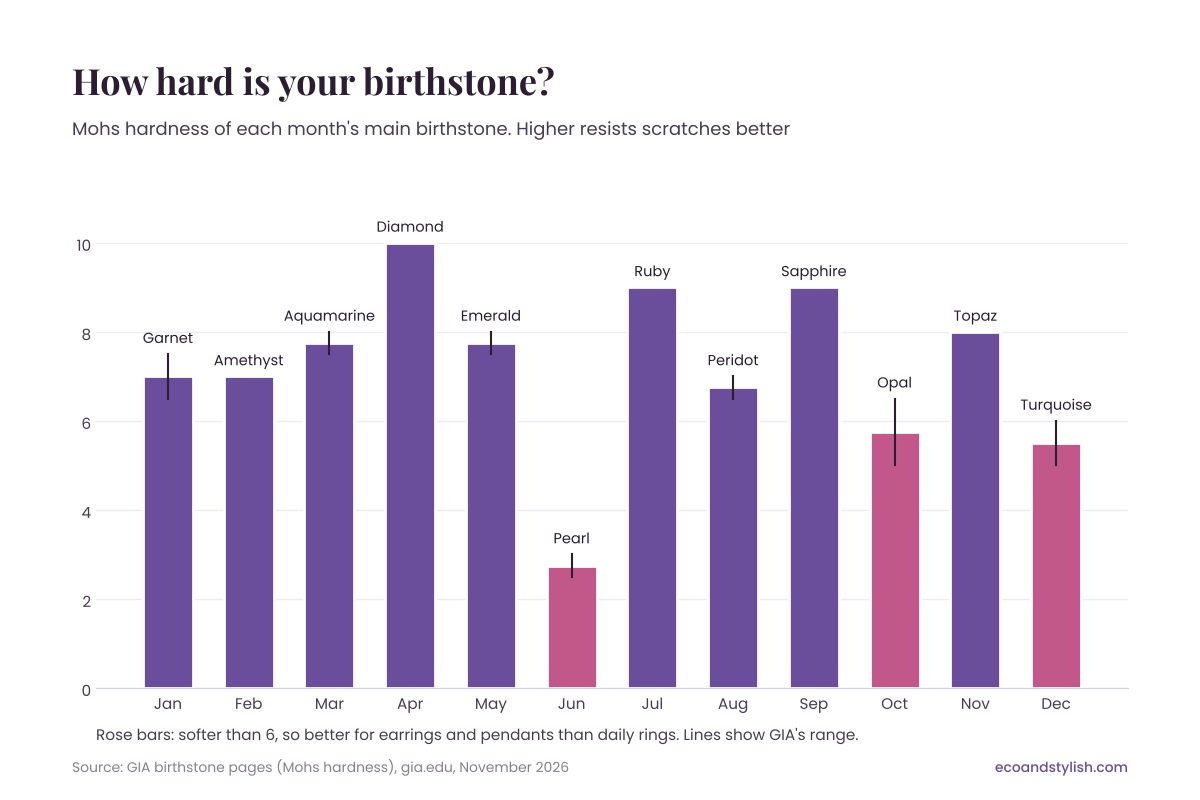
- Best for daily rings: diamond (10), ruby and sapphire (9), topaz (8), aquamarine and emerald (7.5 to 8).
- Wear with some care: garnet, amethyst and peridot, around 6.5 to 7.
- Best for earrings and pendants: pearl (2.5 to 3), opal (5 to 6.5) and turquoise (5 to 6).
Hardness is only one part of the story. GIA judges a stone’s durability by hardness, toughness and stability. Emerald, for example, is hard but can chip because of its inclusions.
Case study: which birthstones do Americans search for most?
I pulled the average monthly US Google searches for each month’s birthstone. June, October and December top the list at about 246,000 searches each, while April is lowest at about 110,000.
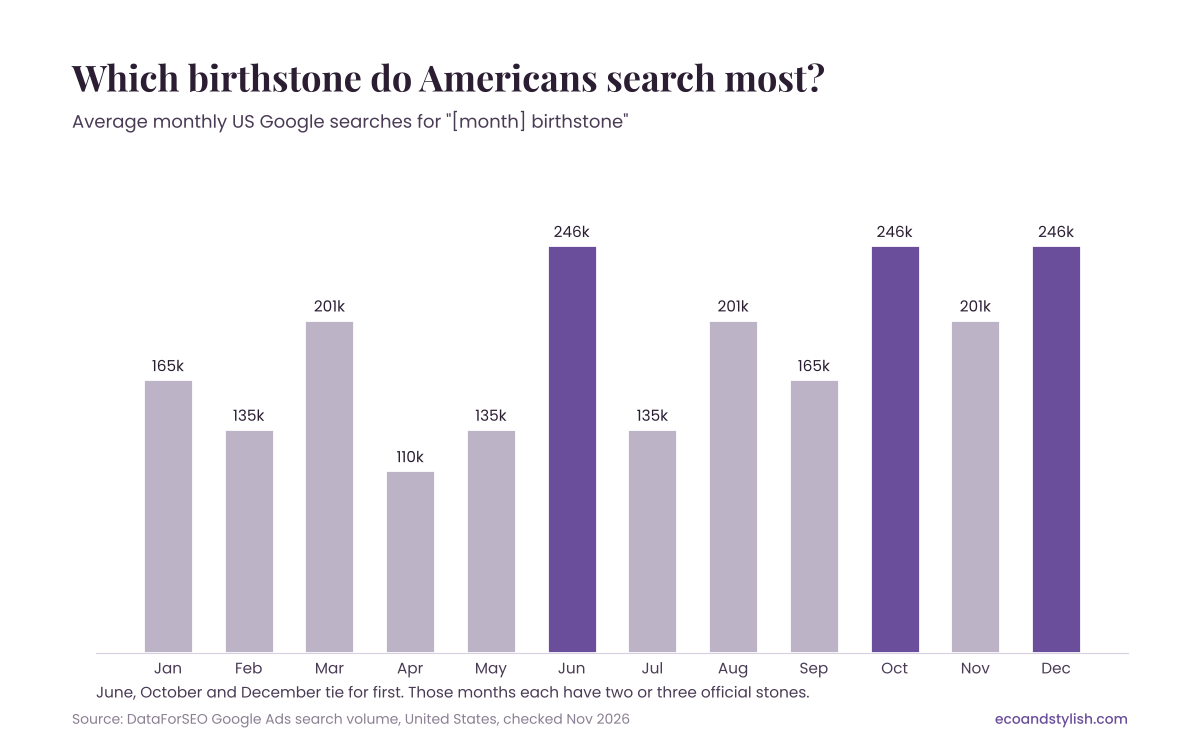
Here is the pattern I noticed. Every month with more than one official birthstone gets at least 201,000 searches. Every month with a single stone gets 165,000 or fewer. On average, months with two or three stones get about 224,000 searches, against about 141,000 for months with one. My reading: when people are not sure which stone is theirs, they search. This is an observation from search data, not a controlled study, but it shows how the list itself shapes what we look up.
The history of birthstones
The idea is ancient. The Book of Exodus describes a breastplate with twelve gemstones worn by the high priest Aaron, and in the first century the historian Josephus linked those twelve stones to the twelve months and signs of the zodiac. The custom of wearing the stone of your own birth month is often traced to Europe in the 1700s.
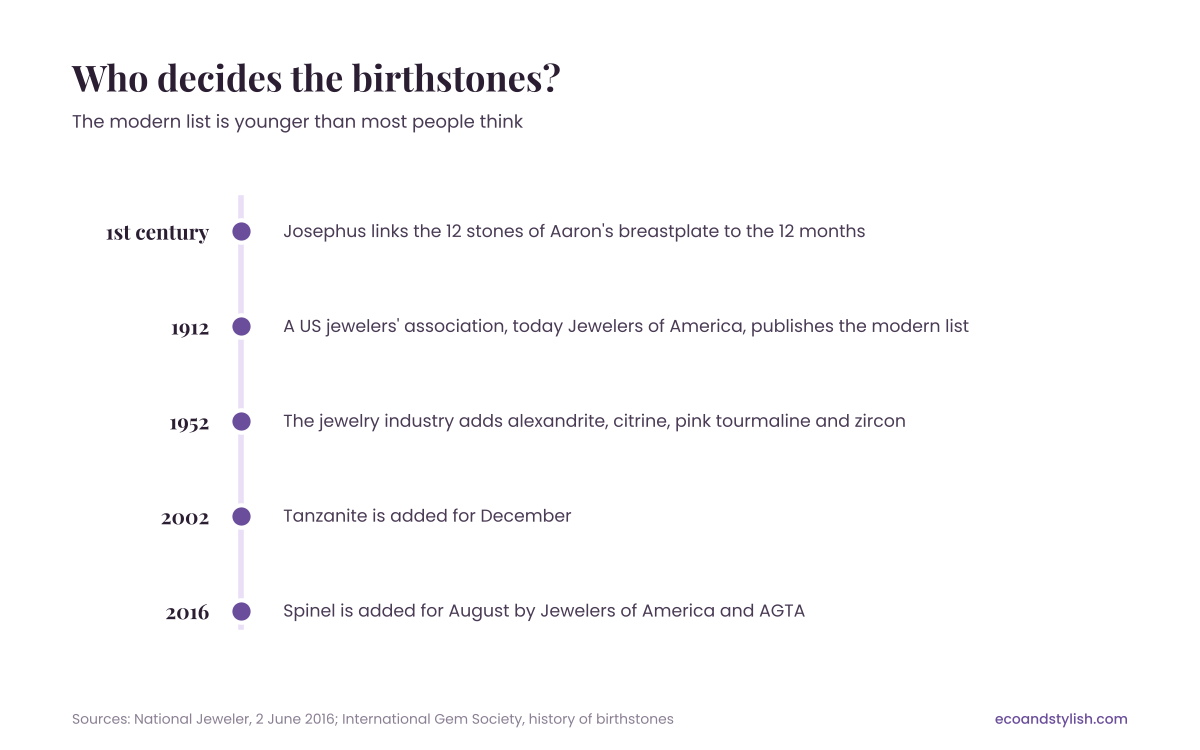
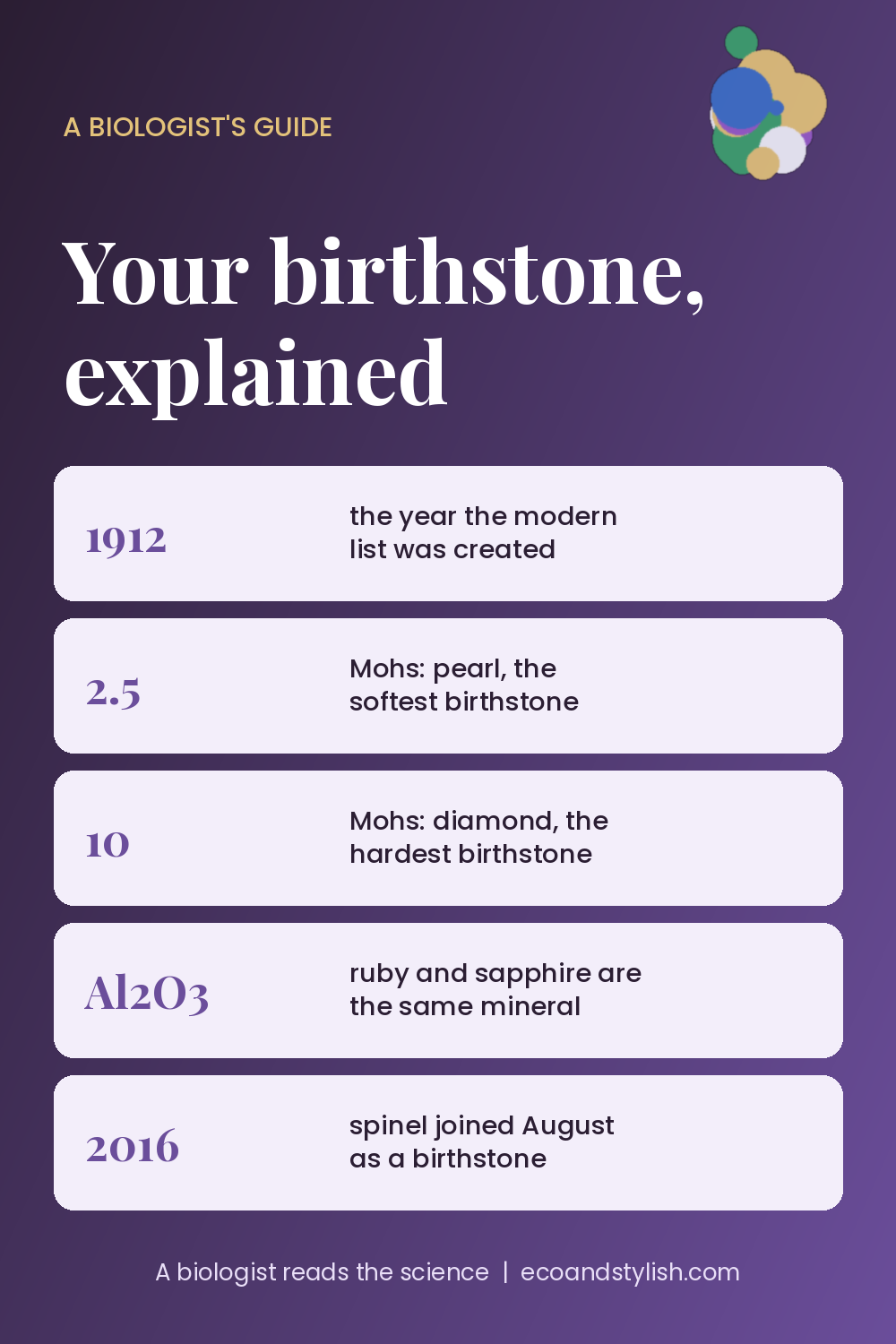
The modern list is much younger. According to National Jeweler, it was officially created in 1912 by the American National Retail Jewelers Association, now Jewelers of America. It was updated in 1952, tanzanite was added for December in 2002, and spinel joined August in 2016, added by Jewelers of America and the American Gem Trade Association.
How to care for your birthstone
- Clean most stones with warm water, mild soap and a soft brush.
- Keep pearls, opals and turquoise away from perfume, hairspray and lotion, and put them on last.
- Avoid ultrasonic and steam cleaners for pearls, opals, emeralds and turquoise.
- Store pieces separately, so a hard diamond or sapphire cannot scratch a softer stone.
Birthstone gift ideas
A birthstone is a personal, lasting gift that can be worn for decades, which makes it a good fit if you want to gift more sustainably. Look for listings that say natural or genuine, and know that lab created stones are real gems with the same chemistry grown in a lab, while crystal or simulated stones are glass or other materials.
1. Genuine Birthstone Stud Earrings
Small 4 mm sterling silver studs, plated in 14K gold, with about 480 reviews. Sold in a range of birthstones. Check the option you pick: some months, like ruby, are lab created, which means real corundum grown in a lab.
2. National Geographic Birthstone Dig Kit
My favorite gift for curious kids, with more than 1,300 reviews. Children dig 12 small gemstone specimens out of a block and learn about each one with a guide and magnifying glass. The stones are tiny specimens, not jewelry quality, and the kit uses blue topaz for December, which is a traditional choice but not on the GIA list.
The bottom line
Every month has at least one official birthstone, and six months have two or three to choose from. Pick the one whose color you love, then let its hardness guide how you wear it: diamonds, rubies and sapphires for everyday rings, and pearls, opals and turquoise for earrings and pendants. And enjoy the science behind it, because each little stone is a story about how our planet, and sometimes a living animal, made something beautiful.
Birthstones FAQ
What are the birthstones by month?
January garnet, February amethyst, March aquamarine and bloodstone, April diamond, May emerald, June pearl, moonstone and alexandrite, July ruby, August peridot and spinel, September sapphire, October opal and tourmaline, November topaz and citrine, December turquoise, tanzanite and zircon.
What is the history of birthstones?
The idea goes back to the twelve stones on Aaron’s breastplate in the Book of Exodus, which the historian Josephus linked to the twelve months in the first century. The modern US list was created in 1912 by the jewelers association now called Jewelers of America and updated in 1952, 2002 and 2016.
What is the birthstone for May?
Emerald is the birthstone for May. It is a green form of the mineral beryl, colored by chromium or vanadium, with a hardness of 7.5 to 8.
What is the weakest birthstone?
Pearl is the softest birthstone, at 2.5 to 3 on the Mohs scale, because it is made by a mollusk from calcium carbonate and protein. Opal and turquoise are also soft and need gentle care.
What is the rarest birthstone?
Among the official birthstones, alexandrite and tanzanite are often called the rarest. Fine alexandrite is scarce, and tanzanite is mined commercially in only one small area of northern Tanzania.
Which months have more than one birthstone?
March, June, August, October, November and December have two or three official birthstones. June and December each have three.
Are ruby and sapphire the same stone?
Yes, both are the mineral corundum, crystallized aluminum oxide. Chromium makes ruby red, while iron and titanium make sapphire blue.

Erzsebet Frey (Eli Frey) is a biologist and science communicator with Bachelor of Science in Biology, and Master of Science in Ecology from the University of Belgrade. Originally from Serbia, she has lived in Sri Lanka since 2017. Eli has worked internationally in countries like Oman, Brazil, Germany, and Sri Lanka. In 2018, she expanded into SEO and blogging, completing courses from UC Davis and Edinburgh. Eli has founded multiple websites focused on biology, ecology, environmental science, sustainable and simple living, and outdoor activities. She enjoys creating nature and simple living videos on YouTube and participates in speleology, diving, and hiking.