
This post contains affiliate links. As an Amazon Associate I earn from qualifying purchases, at no extra cost to you.
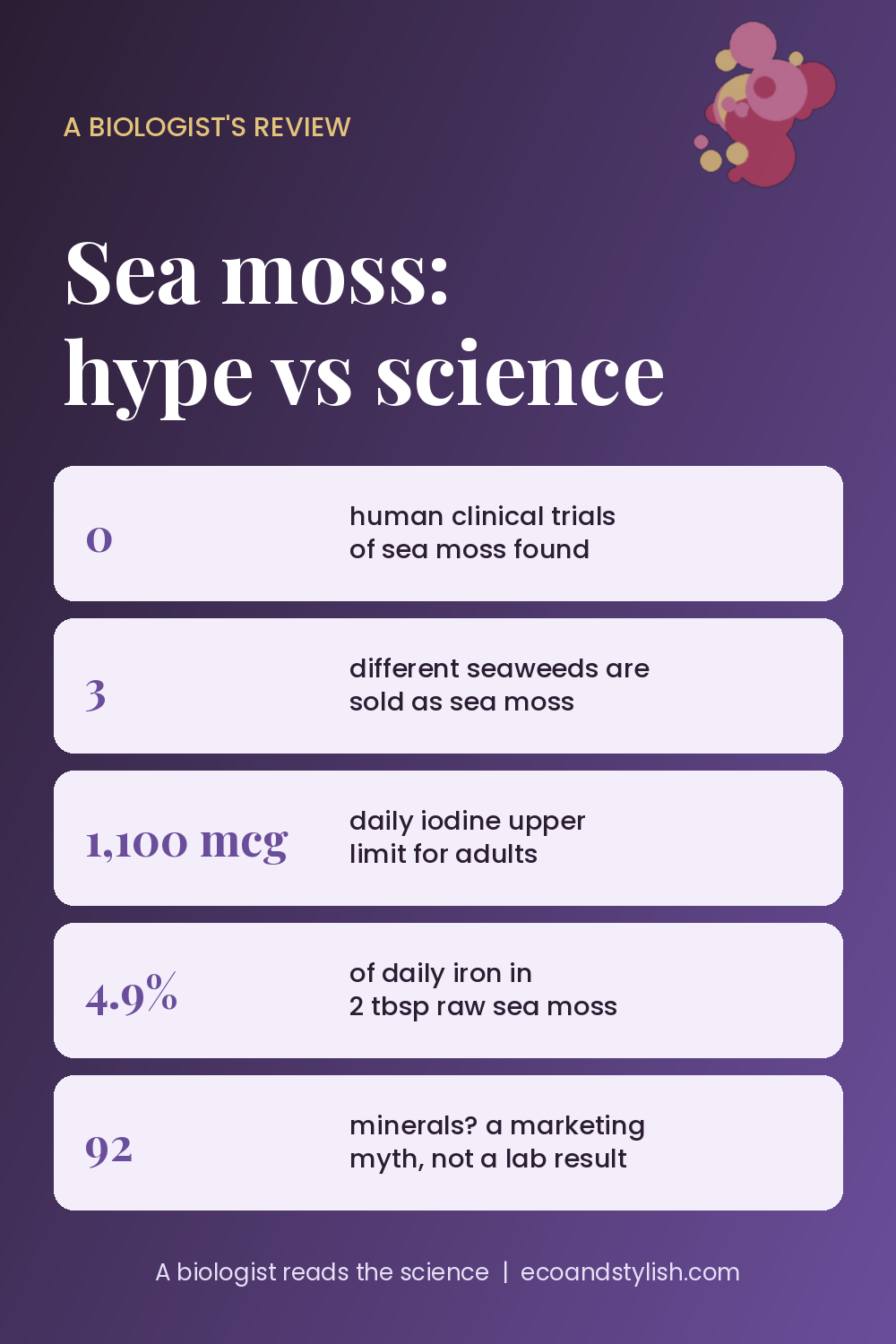
Sea moss is a red seaweed with real nutrition, but most of its famous benefits have never been tested in people. Two tablespoons of raw sea moss give you small amounts of iron, folate and magnesium, about 5 calories and a little iodine. I found no published human clinical trials of sea moss itself. Its biggest real risk is iodine: some seaweeds carry enough to upset your thyroid, so how much you eat, and which seaweed it is, matters more than the hype.
As a biologist, I love seaweeds. They are algae, not plants, and red algae like sea moss are among the oldest groups of complex life on earth. They have fed coastal people for centuries, In Ireland, Irish moss was boiled into milk puddings, and in the Caribbean sea moss is blended into a sweet drink. But between social media and supplement labels, sea moss has picked up claims that run far ahead of the science. Here is what the evidence actually shows.
What is sea moss?
Sea moss is not one species. The name is used for several red seaweeds that look and behave in a similar way, and the one in your jar depends on where it came from.
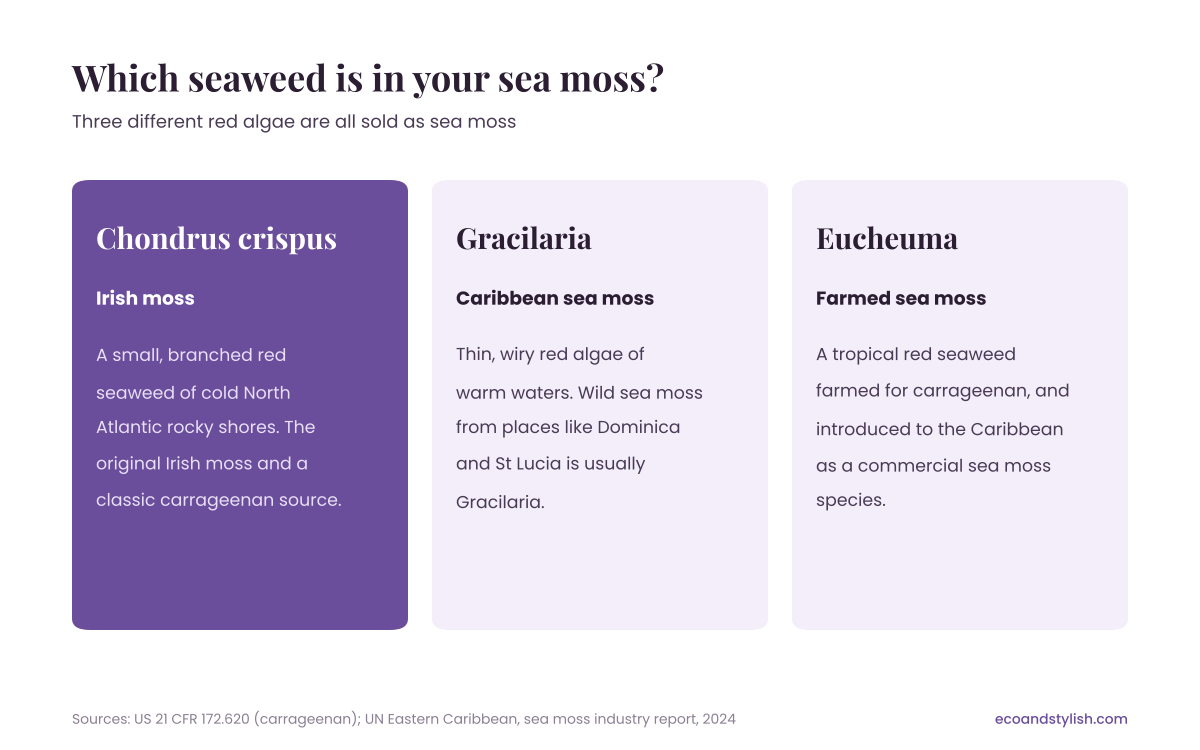
- Chondrus crispus is true Irish moss, a small, branched seaweed of cold North Atlantic rocky shores.
- Gracilaria is a thin, wiry red alga of warm seas. Most wild gold and purple sea moss from the Caribbean is Gracilaria, even when it is labeled Irish moss.
- Eucheuma is a tropical seaweed farmed around the world for carrageenan, and it is also grown and sold as sea moss.
Here is a detail most sellers skip. The gel you make from sea moss comes from the sugars in its cell walls, and they are not the same in every species. Chondrus crispus and Eucheuma make carrageenan, the thickener used in ice cream and plant milks. Gracilaria makes mostly agar, the jelly used in microbiology labs and Asian desserts. So two jars of sea moss gel can be chemically different foods.
Sea moss benefits: what the science says
I searched PubMed and ClinicalTrials.gov for human trials of sea moss, Irish moss and Chondrus crispus as a food or supplement and found none with published results. Most claims rest on three things: the nutrients seaweed contains, lab studies on extracts, and what people report. Here is how each popular claim holds up.
| Claim | What the evidence shows |
|---|---|
| Rich in minerals | True in a small way. A normal serving gives a few percent of daily iron, folate and magnesium. |
| Supports the thyroid | It contains iodine, which the thyroid needs. Too much iodine can also harm the thyroid. |
| Good for gut health | It contains fiber, but only about 0.1 g per 2 tablespoon serving of raw sea moss. |
| Boosts immunity | Only lab and animal studies on seaweed extracts. No human trials of sea moss. |
| Helps you lose belly fat | No evidence. A serving has about 5 calories and very little fiber. |
| Clears your skin | No human trials of eating sea moss. Carrageenan is used in skincare as a thickener. |
Case study: how much nutrition is in a spoon of sea moss?
To test the mineral claims, I used the USDA FoodData Central entry for raw Irish moss. The USDA lists a serving of 2 tablespoons as 10 g. Raw sea moss is about 81% water, so 10 g gives about 5 calories and 0.15 g of protein. I compared each nutrient with the US Daily Value.
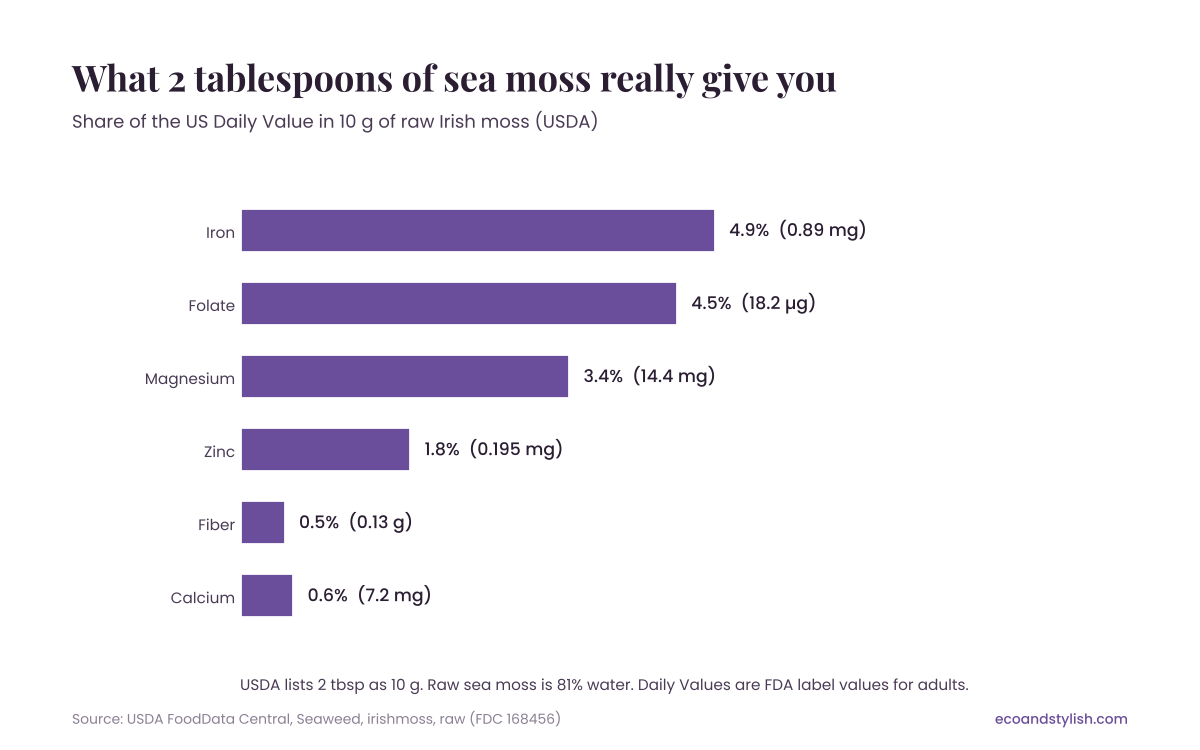
- Iron: 4.9% of the Daily Value, the highest of any nutrient.
- Folate: 4.5%.
- Magnesium: 3.4%.
- Zinc, calcium and fiber: under 2% each.
That is a respectable little boost from a tiny serving, but it is not a superfood dose. A handful of pumpkin seeds or a bowl of lentils gives you far more iron and magnesium.
The 92 minerals myth
Many jars promise 92 of the 102 minerals your body needs. I could not find any lab analysis behind that number. The USDA entry measures about ten minerals in Irish moss. Seaweeds do absorb many elements from seawater, but some of those, like arsenic, cadmium and lead, are ones you would rather avoid. A long list of elements is not automatically a benefit.
The real risk: iodine
Iodine is the one nutrient where sea moss can matter a lot, in both directions. According to the NIH Office of Dietary Supplements, adults need 150 mcg of iodine a day, the safe upper limit is 1,100 mcg a day, and the iodine in seaweeds ranges from about 16 to 2,984 mcg per gram. Too much iodine can cause thyroid problems, especially in people who already have thyroid disease.
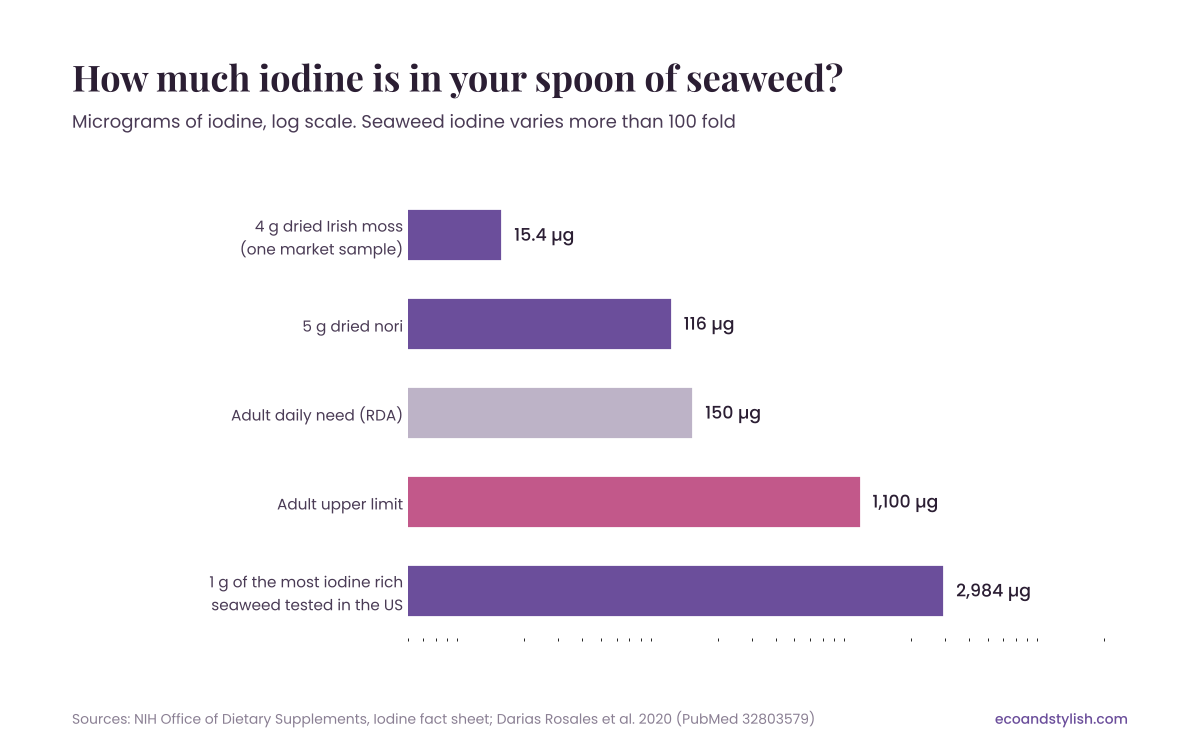
The good news for Irish moss: in a 2020 study by Darias Rosales and colleagues, the Irish moss they tested had about 3.9 mg of iodine per kilogram of dry weight. At 4 g a day, it posed no iodine risk. But that is one product in one study. Iodine in seaweed varies with species, location and season, and most sea moss sold online is never tested.
Who should not take sea moss?
- People with a thyroid condition, or who take thyroid medicine, unless their doctor agrees.
- Anyone already taking iodine, kelp or other seaweed supplements, since iodine adds up.
- People who are pregnant or breastfeeding, who should ask their doctor because iodine needs and limits matter for the baby too.
- Anyone who notices bloating or digestive upset after sea moss gel.
Is carrageenan safe?
Carrageenan is approved as a food additive in the US under federal food rules, and in 2018 the European Food Safety Authority reviewed it, kept it approved, and set a temporary acceptable daily intake of 75 mg per kilogram of body weight while asking for more data. Some people still prefer to avoid it because of animal studies on gut inflammation, many of which used a degraded form that is not allowed in food. A spoon of sea moss gel is a small amount, but this is an open area of research.
How to choose and use sea moss
- Buy dried, whole sea moss that names its origin, and ideally its species, rather than capsules or gummies with long ingredient lists.
- Look for sellers who share heavy metal tests. Seaweeds can absorb metals from the water they grow in.
- Skip the 92 minerals blends that mix sea moss with bladderwrack and burdock root. Bladderwrack is a brown seaweed that can be much richer in iodine.
- Keep servings small, around 1 to 2 tablespoons of gel a day.
- Make the gel yourself: rinse well, soak for 12 to 24 hours, then blend with fresh water. A good blender from these sustainable kitchen gadgets makes it smooth, and most makers suggest using it within about 2 to 3 weeks in the fridge.
- Stir it into smoothies, oats or soups, and sip smoothies through one of these reusable stainless steel straws instead of plastic.
Best dried sea moss
I chose these because the listing names the origin or the species and sells whole dried seaweed, not a blend.
| Sea moss | Seaweed | Best for |
|---|---|---|
| Raw Wildcrafted Gold Sea Moss, St. Lucia | Caribbean, likely Gracilaria | Most reviewed, best value |
| Elderwise Purple Sea Moss | Gracilaria, named | Species named on label |
| Herba Organica Irish Moss | Chondrus crispus | True Irish moss |
1. Raw Wildcrafted Gold Sea Moss from St. Lucia
Wildcrafted and sun dried in St. Lucia, sold as a pack of two 8 oz bags, with about 9,900 reviews and a 4.6 star average. The listing calls it Irish moss, but Caribbean gold sea moss is usually Gracilaria, so expect an agar rich gel.
2. Elderwise Purple Sea Moss
One of the few listings that names its species, sun dried wildcrafted Gracilaria, with about 900 reviews and a 4.4 star average. A good choice if you want to know exactly what you are eating.
3. Herba Organica Irish Moss, Chondrus crispus
True Irish moss, Chondrus crispus, hand picked and sold dried as an herbal tea. It has a lower 3.9 star average from about 50 reviews, but it is a rare chance to buy the carrageenan rich North Atlantic species the old recipes used.
The bottom line
Sea moss is a real food with a long history and a little nutrition to offer, mainly iron, folate and magnesium. It is not a proven cure for anything, and the 92 minerals claim has no data behind it. If you enjoy it, buy whole dried sea moss from a seller who names its origin, keep servings small, and talk to your doctor first if you have a thyroid condition or are pregnant.
This article is for education only and is not medical advice. Talk to your doctor before adding sea moss or any seaweed supplement, especially if you have a thyroid condition, take medicine, or are pregnant or breastfeeding.
Sea moss FAQ
What are the real benefits of sea moss?
Sea moss gives small amounts of iron, folate, magnesium and iodine. Two tablespoons of raw Irish moss provide about 4.9% of the daily value for iron. Claims about immunity, weight loss and skin have not been tested in human trials.
Does sea moss reduce belly fat?
There is no evidence that sea moss reduces belly fat. A 2 tablespoon serving of raw sea moss has about 5 calories and only about 0.1 g of fiber.
Who should not drink sea moss?
People with thyroid conditions or on thyroid medicine, people already taking iodine or kelp supplements, and people who are pregnant or breastfeeding should talk to a doctor first, because sea moss contains iodine.
Does sea moss really have 92 minerals?
There is no published lab analysis showing that sea moss contains 92 minerals. The USDA measures about ten minerals in raw Irish moss, mostly in small amounts.
Is sea moss better than collagen?
Sea moss contains no collagen. Collagen is an animal protein, and seaweeds do not make it. Sea moss is mostly water, carbohydrate and a small amount of protein.
What does sea moss do for your face?
No human trials have tested eating sea moss for skin. In skincare, carrageenan from red seaweeds is used as a thickener and to help products hold moisture.
How much sea moss should you eat a day?
Keep it to about 1 to 2 tablespoons of gel a day. Iodine in seaweed varies widely, and adults should stay under the upper limit of 1,100 mcg of iodine a day from all sources.

Erzsebet Frey (Eli Frey) is a biologist and science communicator with Bachelor of Science in Biology, and Master of Science in Ecology from the University of Belgrade. Originally from Serbia, she has lived in Sri Lanka since 2017. Eli has worked internationally in countries like Oman, Brazil, Germany, and Sri Lanka. In 2018, she expanded into SEO and blogging, completing courses from UC Davis and Edinburgh. Eli has founded multiple websites focused on biology, ecology, environmental science, sustainable and simple living, and outdoor activities. She enjoys creating nature and simple living videos on YouTube and participates in speleology, diving, and hiking.