
This post contains affiliate links. As an Amazon Associate I earn from qualifying purchases, at no extra cost to you.
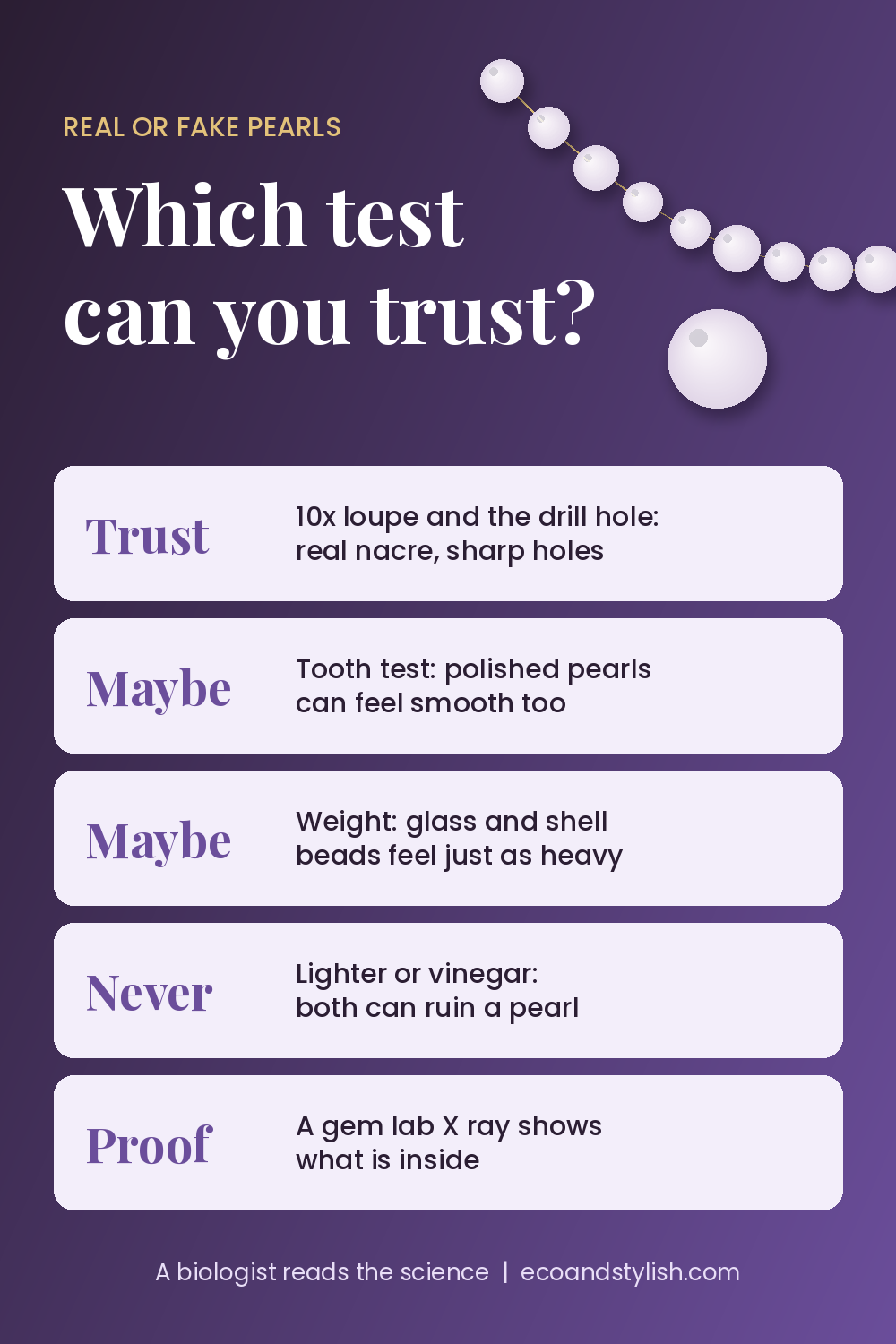
To tell if pearls are real, look at them under a 10x loupe and check the drill holes. Real pearls show fine, uneven ridges on the surface and a clean, sharp hole where you can often see the layers of nacre. Fake pearls look smooth or grainy, and their coating often chips or flakes around the hole. The famous tooth test is a useful hint, but it can be wrong, and only a gem lab X ray can tell you for certain.
As a biologist, I find pearls one of the most beautiful things a living animal makes. A pearl is a mollusk’s way of protecting itself: when something gets inside its shell, the animal wraps it in layer after layer of the same material that lines its shell. Once you understand how that material is built, every pearl test suddenly makes sense.
In this guide I rank every common test by how much you can trust it, explain the two tests that can destroy a pearl, and show you what a jeweler does to know for sure.
What a real pearl is made of
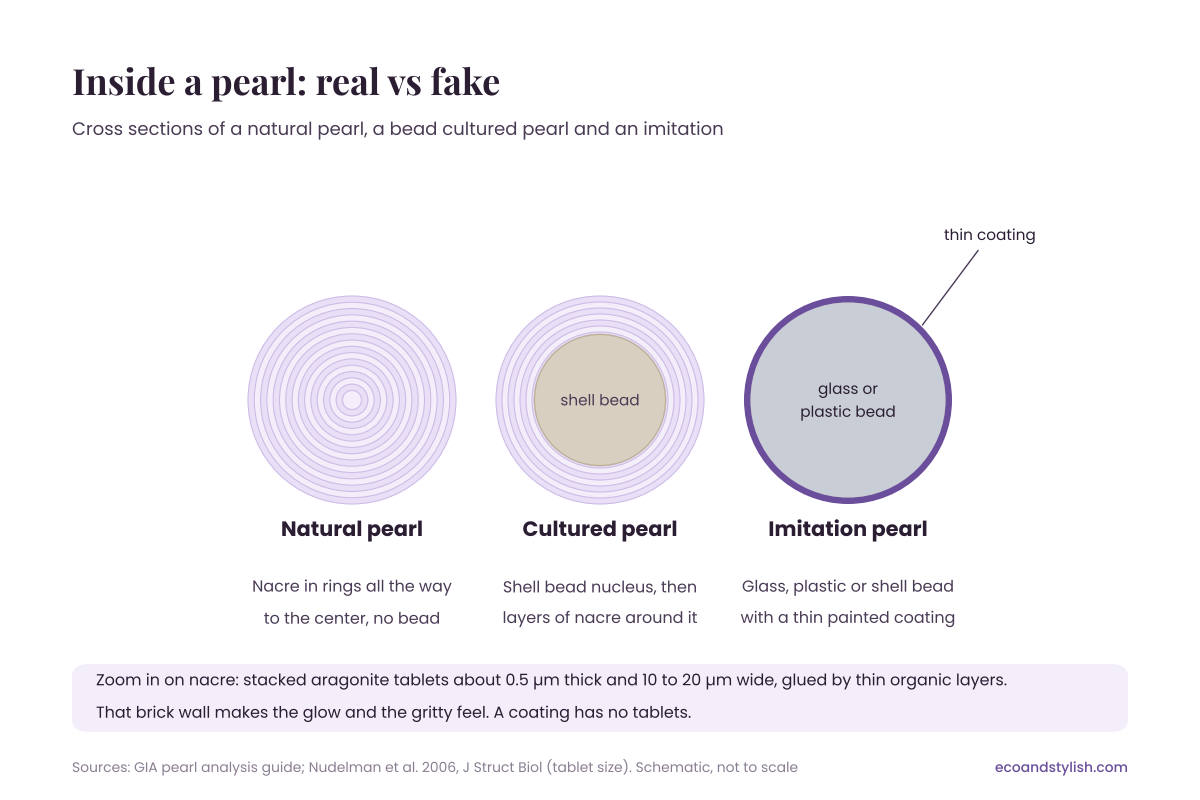
Real pearls are made of nacre, also called mother of pearl. Under a microscope nacre looks like a tiny brick wall: flat crystals of aragonite, a form of calcium carbonate, about 0.5 micrometers (µm) thick and 10 to 20 µm wide, stacked in layers and glued together by thin sheets of organic material (Nudelman and colleagues, 2006). Because each crystal layer is about as thick as a wavelength of visible light, light bounces between the layers and creates that soft inner glow called luster.
There are three kinds of pearls you will meet:
- Natural pearls form inside a wild mollusk without any human help. They are rare and valuable, and inside they are nacre in rings all the way to the center.
- Cultured pearls are real pearls too. A pearl farmer places a shell bead or a piece of tissue inside the mollusk, and the animal coats it with nacre. Almost all real pearls sold today are cultured, and freshwater cultured pearls are the most commonly produced.
- Imitation pearls are not pearls at all. They are glass, plastic or shell beads covered with a thin, shiny coating.
How to tell if pearls are real: every test ranked
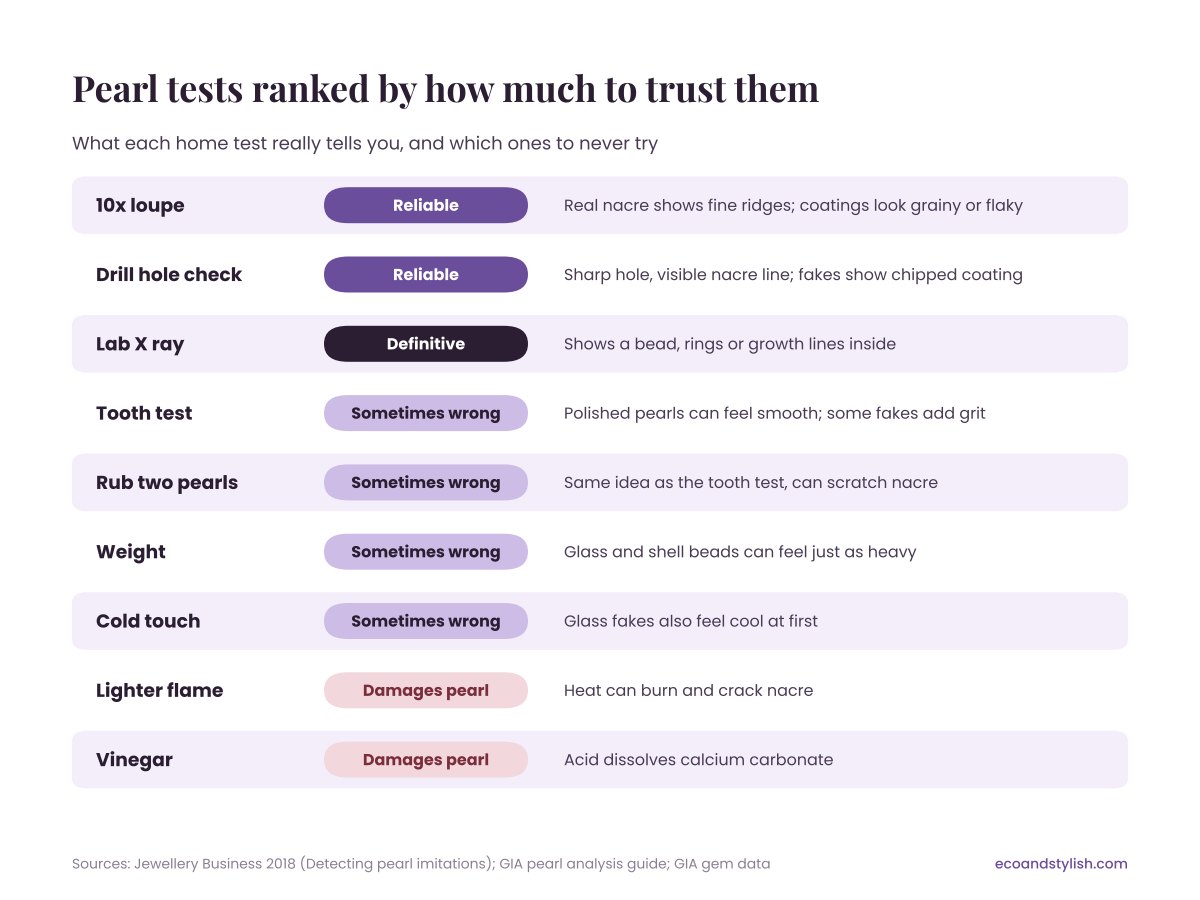
I compared the home tests that appear in almost every guide with what gemologists actually say. Here they are, from most to least trustworthy.
1. Look through a 10x loupe (reliable)
Magnification is the most reliable home test. According to the trade magazine Jewellery Business, it is more reliable and more sanitary than the tooth test. Under a 10x loupe, real nacre shows fine, uneven lines that look a little like a topographic map. Imitations look too smooth and perfect, or grainy, like paint.
2. Check the drill holes (reliable)
Look closely at the hole where the string goes in. Cultured pearls often show a clear dividing line between the nacre and the bead inside, and the edge of the hole is crisp. Imitations usually have a very thin coating, so the edges look ragged, chipped or peeling, and you may see bare glass or plastic underneath.
3. The tooth test (sometimes wrong)
Gently rub the pearl across the edge of your front teeth. Real nacre usually feels slightly gritty, like very fine sand, because you are feeling the edges of those tiny crystal layers. Most fakes feel smooth and glassy. But the test is not foolproof: well polished real pearls can feel smooth, and some imitations have a gritty substance added to their coating to trick exactly this test.
4. Rub two pearls together (sometimes wrong)
Real pearls feel slightly rough against each other and may leave a fine powder. It is the same idea as the tooth test, with the same weaknesses, and it can scratch the nacre if you press hard. Do it very gently, if at all.
5. Feel the weight (sometimes wrong)
Pearls are dense. GIA lists their specific gravity at 2.60 to 2.85, so they feel heavier than they look. A strand that feels surprisingly light is probably plastic. But glass and coated shell beads can feel just as heavy as real pearls, so weight alone proves nothing.
6. The cold touch (sometimes wrong)
Real pearls feel cool against your skin at first and then warm up. Plastic feels warm almost immediately. Glass, however, also feels cool, so this test only helps you rule out plastic.
7. Look at the shape and color of the whole strand (a hint)
Real pearls are rarely perfectly identical. Small differences in shape, size and overtone between pearls on a strand are normal. A strand where every bead is a flawless, identical sphere deserves a closer look with the loupe.
Two tests that can destroy your pearls
Some websites still suggest these tests. Please do not use them on anything you care about.
- The lighter or flame test. Nacre contains organic material between its crystal layers. Heat can burn that material, discolor the pearl and crack the surface.
- The vinegar test. Pearls are made of calcium carbonate, the same mineral as chalk and limestone. Vinegar is an acid, and acid dissolves calcium carbonate. A real pearl will start to fizz and lose its luster, which means the test works by damaging the very thing you want to protect.
The same chemistry explains how to care for pearls: keep them away from perfume, hairspray and acidic cleaners, and put them on last when you get dressed. With a hardness of only 2.5 to 3.0 on the Mohs scale, pearls also scratch easily, so store them apart from harder jewelry.
How a jeweler tells if a pearl is real
A jeweler will usually start with the same loupe and drill hole checks. For certainty, a gem lab uses X rays. According to GIA, the Gemological Institute of America, X ray images show the inside of the pearl: natural pearls typically show rings of growth with no solid nucleus, bead cultured pearls show a central core with nacre around it, and non bead cultured pearls show irregular growth lines or a small void. For difficult cases, labs also use 3D micro CT scans.
If your pearls may be valuable, a lab report is the only way to know if they are natural, cultured or imitation, and it is what an insurer or a buyer will ask for.
Case study: what people really want to know about pearls
To see what readers worry about most, I looked at US Google search data for pearl questions. The question of whether pearls are real is searched about 14,800 times a month, more than cultured pearls (8,100) or how pearls form (6,600). Add the related searches, like how to tell real pearls from fake (4,400) and real vs fake pearls (1,300), and real vs fake is clearly the biggest pearl question people have.
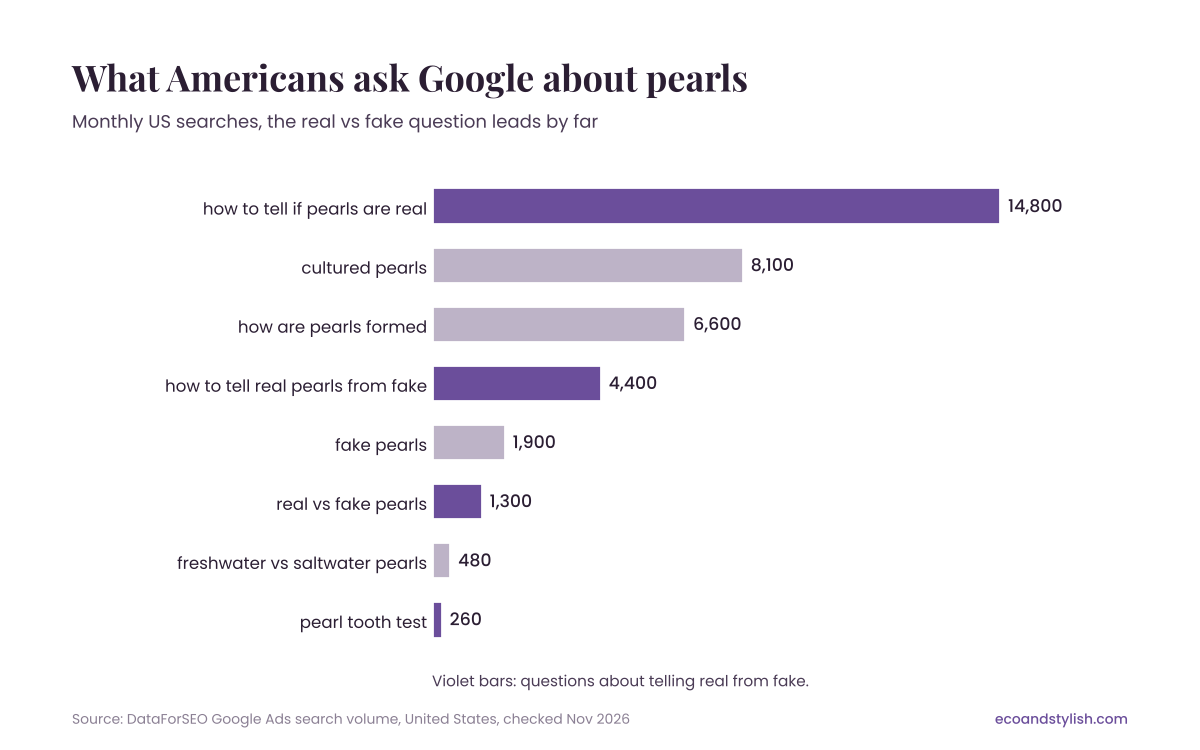
Yet almost every top ranking guide treats the tooth test as if it were proof. The gap between what people search and what gemologists actually recommend is the reason I wrote this guide: the loupe and the drill hole beat your teeth every time.
Are grandma’s pearls worth anything?
They might be. Start with clues on the strand itself:
- Knots between each pearl usually mean someone cared about the strand. Real pearls are traditionally strung on silk with a knot between each pearl so they cannot rub against each other.
- The clasp can tell a story. A clasp stamped 14K, 18K or 925 suggests a piece made to last, although it does not prove the pearls are real.
- Peeling is a warning sign. Imitation coatings often wear through with age and show the glass or plastic bead underneath, especially around the drill holes.
Cultured pearls only became widely sold in the 20th century, so a very old strand could even be natural. If the loupe and drill hole checks point to real pearls, take the strand to a jeweler or a gem lab before you sell or insure it.
How much do real pearls cost?
Price depends on the type of pearl, its size, luster, nacre quality and how well the pearls match. As a rule, freshwater cultured pearls are the most affordable, Akoya pearls from Japan and China cost more, and Tahitian and South Sea pearls are the most expensive cultured pearls. Natural pearls are rare and priced in a league of their own. If a full strand of large, perfectly round pearls is sold for very little, be suspicious.
Where to buy real pearls
Buy from sellers that clearly say cultured pearl, name the type (freshwater, Akoya, Tahitian or South Sea) and offer returns. Pearls are also one of the most timeless pieces for a capsule wardrobe, and a lovely, long lasting gift if you are trying to gift more sustainably. These are well reviewed options on Amazon that are listed as genuine cultured pearls:
1. The Pearl Source Akoya Pearl Necklace
A classic white Akoya strand, listed as AAA grade genuine cultured Akoya pearls. Akoya pearls are known for their bright, mirror like luster, and this is the closest thing to the traditional pearl necklace most people picture.
2. The Pearl Source Freshwater Pearl Necklace
The same seller’s freshwater cultured strand, with nearly 3,000 Amazon reviews. Freshwater pearls are softer in luster but very durable, and a great first real pearl necklace at a lower price.
3. JORA Freshwater Cultured Pearl Stud Earrings
Simple button pearl studs in sterling silver with more than 3,600 reviews. Everyday pearls you can wear with jeans or a dress.
4. Freshwater Cultured Pearl Necklace, Bracelet and Earring Set
A matching three piece set listed as freshwater cultured pearls, with more than 4,000 reviews. A thoughtful gift that covers every occasion.
5. 10x Triplet Jeweler’s Loupe
The single best tool for testing pearls at home, and useful for gemstones, coins and even insects. A triplet lens gives a sharp, color true image at 10x, the standard magnification jewelers use.
The bottom line
A real pearl is a small biological wonder, built crystal by crystal by a living animal. To tell if yours are real, trust your eyes and a loupe more than your teeth: look for fine, uneven nacre on the surface and crisp drill holes with layers you can see. Never use fire or vinegar. And if your pearls may be valuable, let a gem lab X ray tell you exactly what they are.
Real vs fake pearls FAQ
How does a jeweler tell if a pearl is real?
A jeweler examines the surface and drill holes under magnification. For certainty, a gem lab uses X ray imaging, which shows whether the pearl has natural growth rings, a cultured bead nucleus, or is an imitation bead with a coating.
Are grandma’s pearls worth anything?
They can be. Knots between pearls, a gold stamped clasp and soft surface wear are good signs. Very old strands may even be natural pearls, so have them checked by a jeweler or gem lab before selling or insuring them.
How to identify a vintage pearl necklace?
Check the knots, the clasp and the drill holes, and look at the surface under a 10x loupe. Real vintage pearls show fine nacre ridges and crisp holes, while imitation coatings tend to peel or chip around the holes.
How much do real pearls cost?
It depends on type, size, luster and matching. Freshwater cultured pearls are the most affordable, Akoya pearls cost more, and Tahitian and South Sea pearls are the most expensive cultured pearls. Natural pearls are rare and far more valuable.
Where are real pearls found?
Natural pearls grow inside wild oysters and mussels in seas and rivers. Most pearls sold today are cultured on pearl farms, with freshwater cultured pearls being the most commonly produced.
Does the tooth test work on pearls?
Often, but not always. Real nacre usually feels gritty against your teeth, but polished real pearls can feel smooth and some imitations add grit to their coating. A 10x loupe and a drill hole check are more reliable.

Erzsebet Frey (Eli Frey) is a biologist and science communicator with Bachelor of Science in Biology, and Master of Science in Ecology from the University of Belgrade. Originally from Serbia, she has lived in Sri Lanka since 2017. Eli has worked internationally in countries like Oman, Brazil, Germany, and Sri Lanka. In 2018, she expanded into SEO and blogging, completing courses from UC Davis and Edinburgh. Eli has founded multiple websites focused on biology, ecology, environmental science, sustainable and simple living, and outdoor activities. She enjoys creating nature and simple living videos on YouTube and participates in speleology, diving, and hiking.