
This post contains affiliate links. As an Amazon Associate I earn from qualifying purchases, at no extra cost to you.
The best air purifier for mold is a true HEPA purifier sized for your room, like the Coway Airmega AP-1512HH or the Honeywell HPA300. HEPA filters trap mold spores very well, because spores are roughly 10 to 16 times wider than the particle size HEPA is tested on. But no air purifier can fix a mold problem. It only cleans the air while you fix the moisture that feeds the mold.
Mold is more common than most people think. In North American surveys, 27 to 36% of homes reported mold problems, and studies that actually measured the air found even more, 42 to 56%, as summarized in a 2002 study by Górny and colleagues.
As a biologist I find mold fascinating. A fungus is a quiet, brilliant survivor that sends out millions of microscopic spores to find the next damp corner. That is exactly why fighting it with a machine alone never works. So in this guide I go through the science first, then the purifiers worth buying.
Do air purifiers help with mold?
Yes, but only with the part of mold that floats. A good HEPA purifier pulls spores and tiny mold fragments out of the air you breathe, which can ease allergy symptoms and that stale, musty feeling. It does nothing to the mold growing on your wall, under your sink or behind the shower tiles.
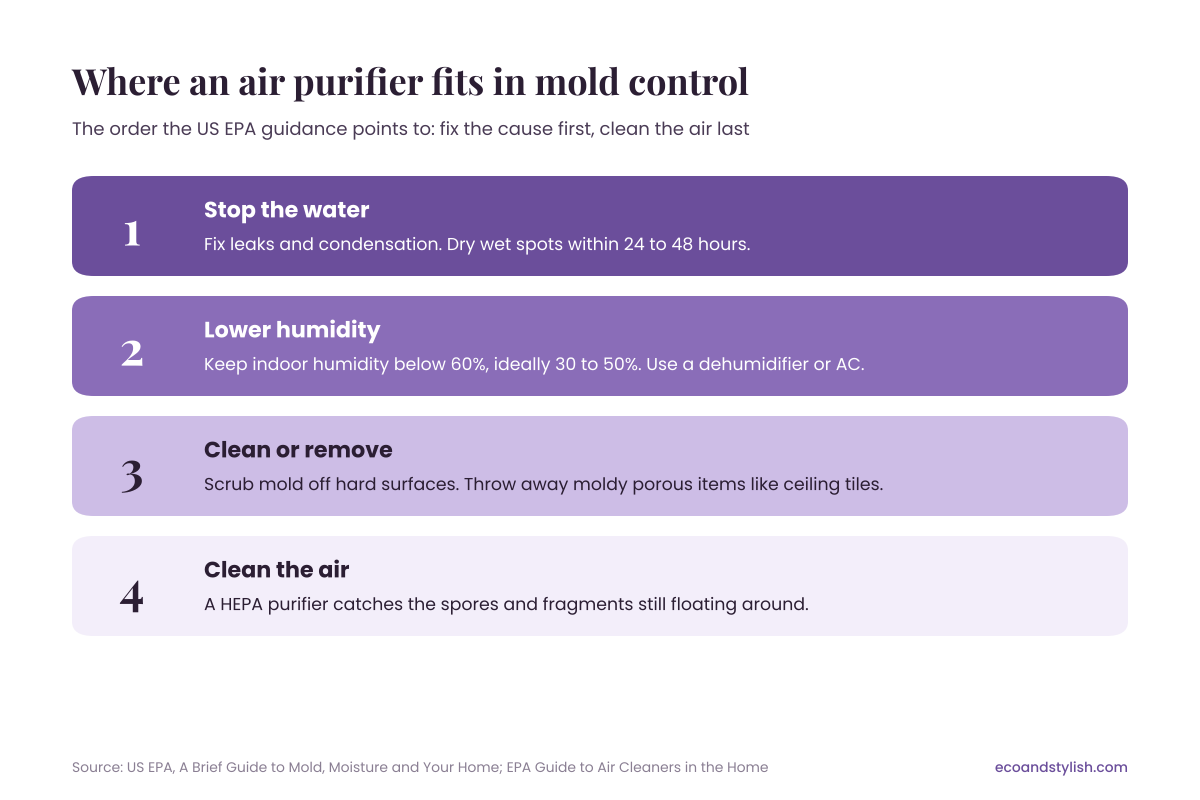
The US EPA says it plainly in its guide to air cleaners: portable air cleaners and furnace filters do not address the cause of mold and musty odors. Its mold guide adds a second hard truth. It is impossible to get rid of all mold and mold spores indoors, because spores drift in from outside every day. The goal is not a sterile home. The goal is a home where mold has no water to grow on.
What filter is best for mold?
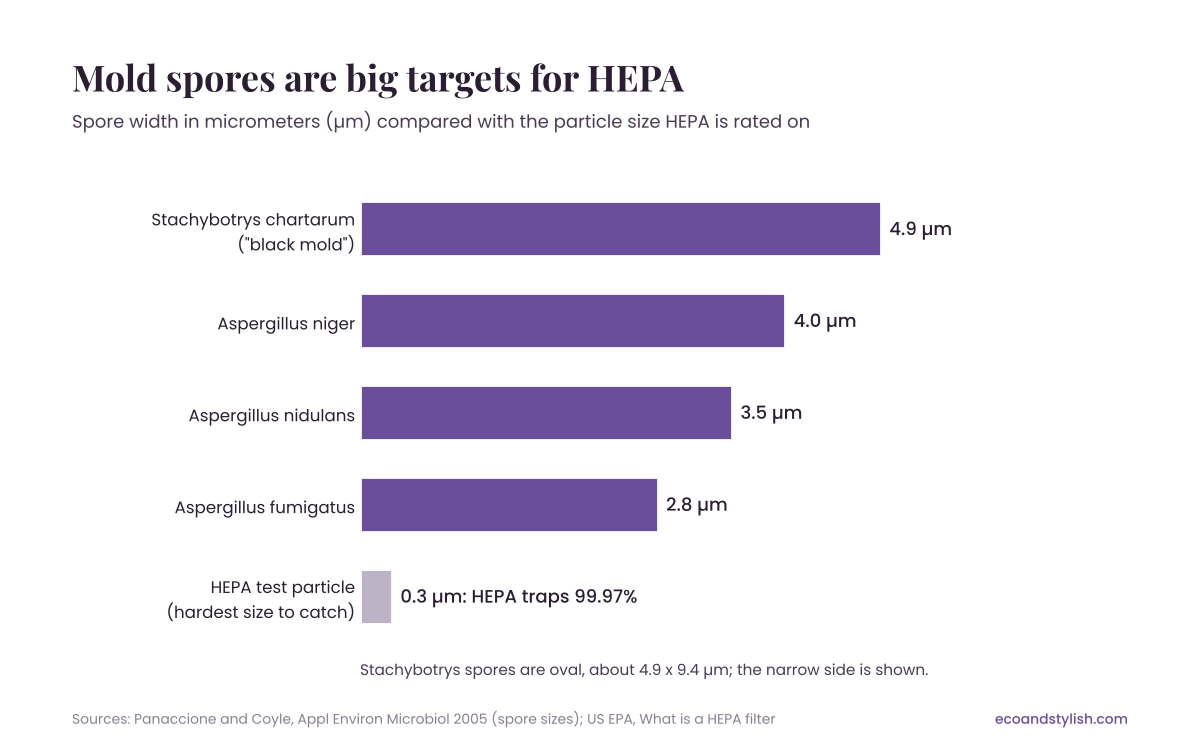
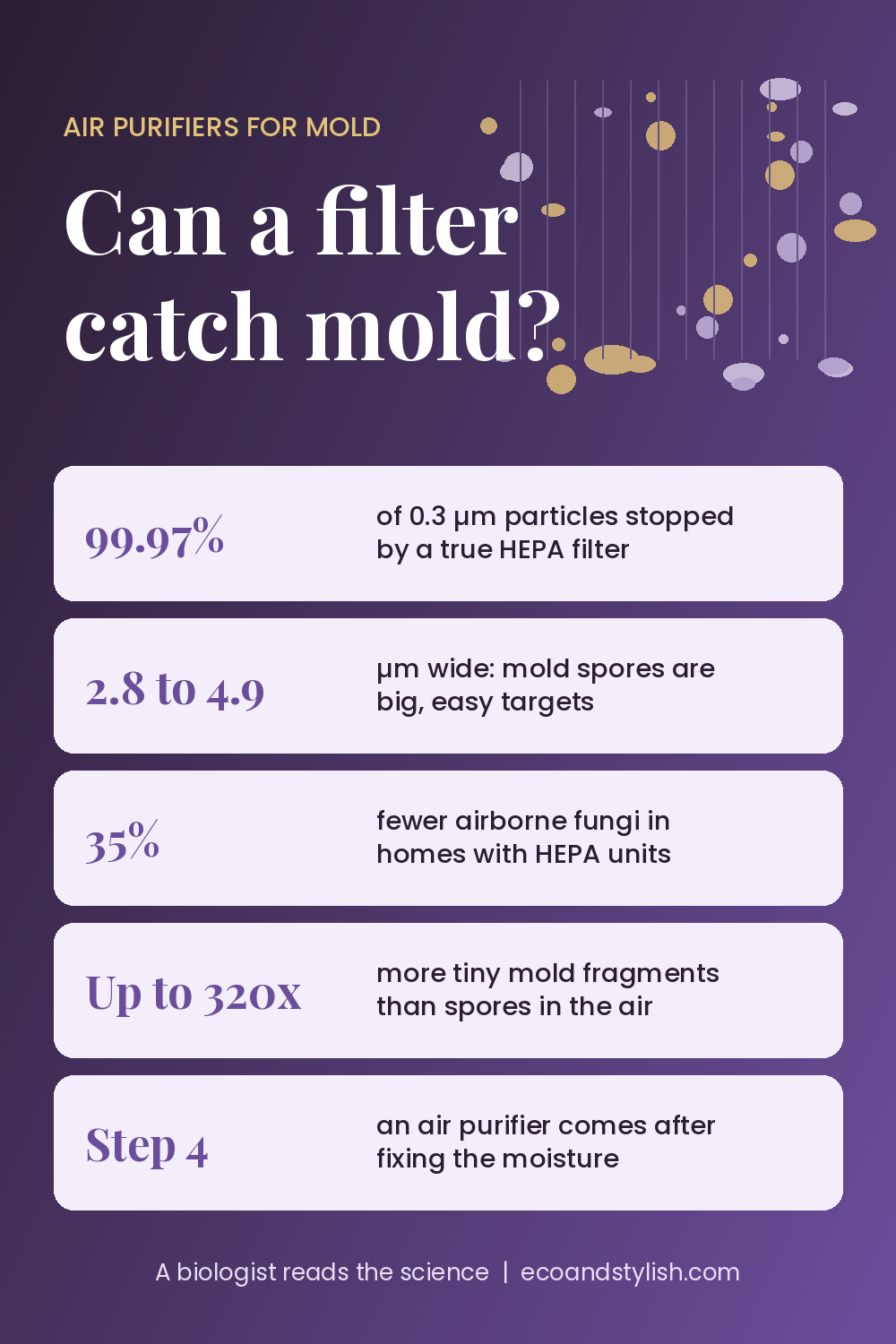
A true HEPA filter. According to the US EPA, a HEPA filter can remove at least 99.97% of airborne particles at 0.3 micrometers (µm). That size is not random. It is the hardest size to catch, so particles that are larger or smaller are trapped even more efficiently.
- True HEPA: the gold standard for mold spores. Look for the words true HEPA or H13, not HEPA type or HEPA style, which are marketing terms without the same standard.
- Activated carbon: does not catch spores, but it absorbs the musty smelling gases mold releases. Most good purifiers pair carbon with HEPA.
- MERV 13 furnace filters: a good upgrade for central heating and air systems, but they only clean air while the system fan runs.
- Avoid ozone generators: they release ozone on purpose, and the EPA notes that no federal agency has approved them for use in occupied spaces. Ozone irritates your lungs and does not reliably kill mold.
- Ionizers and UV lights: optional extras. Spores rush past a small UV lamp in a fraction of a second, so the HEPA filter does the real work. If a purifier has an ionizer, choose one you can switch off.
Case study: can a HEPA filter really catch mold?
To answer this properly I compared three things: how big mold spores are, how HEPA filters are tested, and what happened when researchers actually put HEPA purifiers into real homes.
1. Mold spores are big targets
In a 2005 study in Applied and Environmental Microbiology, Panaccione and Coyle measured the spores of common indoor molds. Aspergillus fumigatus spores were 2.8 µm wide, Aspergillus niger 4.0 µm, and the spores of Stachybotrys chartarum, the famous black mold, measured about 4.9 by 9.4 µm. Every one of them is roughly 9 to 16 times wider than the 0.3 µm test particle.
2. The hidden twist: mold fragments
Here is the part most buying guides leave out. Mold does not only release spores. In a 2002 chamber study, Górny and colleagues found that moldy ceiling tiles and surfaces released tiny fungal fragments in numbers up to 320 times higher than the spores themselves. These fragments carry the same allergens. The good news is that HEPA filters also trap very small particles efficiently, which is one more reason to choose true HEPA over cheaper filters.
3. What happened in real homes
Lab numbers are one thing. Real living rooms, with open doors and moving people, are another. In an Australian study, researchers placed portable HEPA units in homes in Perth and tracked the mold in the air. Airborne fungi dropped by 35% and particles by 38% in the filtered homes (Cheong and colleagues, 2004). The most common molds were Penicillium and Cladosporium.
So the honest result is this: a HEPA purifier makes a real, measurable difference, but it does not make the air free of mold. A 35% drop is meaningful for an allergic household. It is not a cure for a damp house.
What size air purifier do you need for mold?
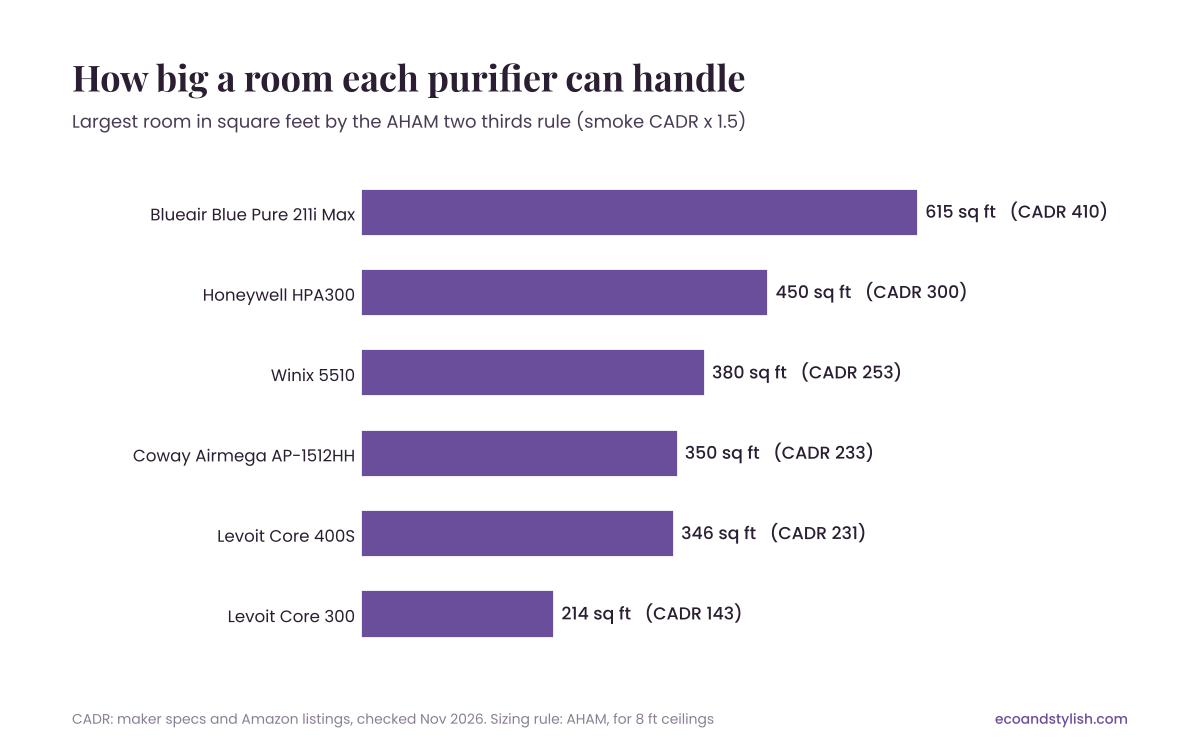
Size matters more than brand. The number to look at is CADR, the clean air delivery rate, which tells you how many cubic feet of filtered air a purifier delivers per minute. The Association of Home Appliance Manufacturers (AHAM) uses a simple two thirds rule: the smoke CADR should be at least two thirds of your room’s area in square feet. A 300 square foot bedroom needs a smoke CADR of at least 200.
If your ceilings are higher than 8 feet, or the room is a damp basement, size up. Run the purifier on a medium setting all the time rather than on high for an hour a day.
Best air purifiers for mold
Every pick below uses a true HEPA filter with activated carbon, and I chose them on published CADR, independent test results and a long record of buyer reviews. Choose by room size first.
| Purifier | Smoke CADR | Room size (two thirds rule) | Best for |
|---|---|---|---|
| Coway Airmega AP-1512HH | 233 | 350 sq ft | Best overall |
| Honeywell HPA300 | 300 | 450 sq ft | Damp basements and large rooms |
| Winix 5510 | 253 | 380 sq ft | Living rooms, smart features |
| Levoit Core 400S | 231 | 346 sq ft | Quiet bedrooms, app control |
| Blueair Blue Pure 211i Max | 410 | 615 sq ft | Open plan spaces |
| Levoit Core 300 | 143 | 214 sq ft | Small rooms on a budget |
1. Coway Airmega AP-1512HH: best overall
The Coway Mighty has been a favorite of independent testers for years. Its CADR is 233 for smoke, 246 for dust and 240 for pollen, it has a true HEPA filter with a carbon layer, and it has close to 30,000 Amazon reviews. In HouseFresh testing it cleared a test room in under 30 minutes and ran at just 38.9 dB on its lowest speed. It has an ionizer, but that has its own button, so you can run it as a plain HEPA purifier.
2. Honeywell HPA300: best for damp basements
A big, simple workhorse with a CADR of 300 for smoke, 320 for dust and 300 for pollen, enough for about 450 square feet. HouseFresh measured it clearing a test room in 20 minutes on top speed. It gets loud on high, and the carbon prefilter needs frequent changes, but for a musty basement this is a lot of clean air for the money.
3. Winix 5510: best for living rooms
The newer version of the popular Winix 5500, now with app control. It lists a CADR of 253 for smoke, 252 for dust and 247 for pollen, and pairs true HEPA with a washable carbon filter. It also has Winix’s PlasmaWave feature, which you can switch off with its own button if you prefer a filter only purifier.
4. Levoit Core 400S: best for quiet bedrooms
A quiet, compact cylinder with verified CADR ratings of 231 for smoke, 240 for dust and 259 for pollen. It pulls air in from all sides, so you can place it in a corner, and the app lets you schedule it while you sleep.
5. Blueair Blue Pure 211i Max: best for open plan spaces
The most powerful pick here, with a listed CADR of 410, enough for an open living and kitchen area of about 600 square feet. It is quiet for its power and the washable fabric prefilter catches pet hair before it reaches the main filter.
6. Levoit Core 300: best budget pick
With more than 100,000 Amazon reviews, this is the most popular small purifier on the market. Its CADR of 143 suits a room of about 200 square feet, like a small bedroom or a home office. Buy the original true HEPA replacement filters, not cheap copies.
Air purifier vs dehumidifier: which do you need for mold?
If you can only buy one, and your home feels damp, buy the dehumidifier first. Mold needs moisture, and the EPA recommends keeping indoor humidity below 60%, ideally between 30 and 50%. A dehumidifier attacks the cause. An air purifier cleans up the effect.
| Dehumidifier | Air purifier | |
|---|---|---|
| What it does | Removes water from the air | Traps spores, fragments and odors |
| Stops new mold growth | Yes, when humidity stays below 60% | No |
| Helps allergy symptoms | Indirectly | Yes, directly |
| Best place | Basements, bathrooms, laundry rooms | Bedrooms and living spaces |
In a damp basement, the best combination is both: a dehumidifier to stop growth and a HEPA purifier to clean the air while the room dries out.
What actually kills mold
For mold on surfaces, removal beats killing. The EPA advises scrubbing mold off hard surfaces with detergent and water and drying them completely, and throwing away porous materials like ceiling tiles and carpet once they are moldy. If you are cleaning small areas yourself, a few good biodegradable cleaning products and sponges you can throw away afterwards, like these biodegradable kitchen sponges, do the job without harsh fumes.
- Dry any wet material within 24 to 48 hours to stop mold from starting.
- Wear gloves, goggles and an N95 mask when you scrub mold.
- If the moldy area is larger than about 10 square feet, or it came from sewage or flood water, call a professional.
- Keep the air purifier running during and after cleaning, because scrubbing releases spores into the air.
The English ivy myth: does a plant remove 78% of mold?
You may have seen the claim that English ivy removes 78% of airborne mold. It comes from a 2005 experiment presented at the American College of Allergy, Asthma and Immunology. A California teenager, Ryan Kim, placed moldy bread in a container, measured the airborne mold, then added an English ivy plant. Mold in the air fell by 78.5%.
It is a lovely piece of curiosity driven science, and it deserves credit. But it was done in a small container, not a room. As the original report itself noted, it did not test what the plant does in a whole house. Keep the ivy for its beauty, and keep the HEPA filter for your lungs.
The bottom line
Mold is a moisture problem first and an air problem second. Fix leaks, dry wet spots quickly and keep humidity under 60%. Then a true HEPA purifier, sized with the two thirds rule, will catch the spores and fragments still floating in your air. For most rooms, the Coway Airmega AP-1512HH is the best all round choice, and the Honeywell HPA300 is the one I would put in a damp basement.
This article is for education only and is not medical advice. If you have asthma, a weakened immune system or ongoing symptoms you think are linked to mold, talk to your doctor.
Air purifier for mold FAQ
Do air purifiers help reduce mold?
Air purifiers with a true HEPA filter reduce mold spores in the air. In real homes, portable HEPA units cut airborne fungi by about 35%. They do not stop mold growing on surfaces, so you still need to fix the moisture source.
What plant removes 78% of airborne mold?
English ivy. The claim comes from a 2005 experiment in which English ivy reduced airborne mold by 78.5% in a small container with moldy bread. It was not tested in a real room, so a plant is no replacement for fixing moisture or using a HEPA purifier.
What kills mold spores best?
On hard surfaces, the EPA recommends scrubbing mold off with detergent and water and drying the area completely. In the air, HEPA filters do not kill spores, they trap them, which is safer than ozone generators.
What filter is best for mold?
A true HEPA filter is best for mold. It removes at least 99.97% of particles at 0.3 micrometers, and mold spores are much larger, about 2.8 to 4.9 micrometers wide. Add activated carbon to absorb musty odors.
What is the most effective air purifier for mold?
The most effective air purifier for mold is a true HEPA model with enough CADR for your room. For most rooms, the Coway Airmega AP-1512HH is a strong all round choice, and the Honeywell HPA300 suits larger damp spaces like basements.
Can air purifiers clean mold out of the air?
They can remove most mold spores and fragments from the air that passes through them, but not all of them. Spores keep coming in from outside and from any active mold growth, so an air purifier works best alongside moisture control.

Erzsebet Frey (Eli Frey) is a biologist and science communicator with Bachelor of Science in Biology, and Master of Science in Ecology from the University of Belgrade. Originally from Serbia, she has lived in Sri Lanka since 2017. Eli has worked internationally in countries like Oman, Brazil, Germany, and Sri Lanka. In 2018, she expanded into SEO and blogging, completing courses from UC Davis and Edinburgh. Eli has founded multiple websites focused on biology, ecology, environmental science, sustainable and simple living, and outdoor activities. She enjoys creating nature and simple living videos on YouTube and participates in speleology, diving, and hiking.