
This post contains affiliate links. As an Amazon Associate I earn from qualifying purchases, at no extra cost to you.
The best vitamin C serum is one that contains L ascorbic acid, the pure form of vitamin C, at 10 to 20%, in an acidic formula with vitamin E and ferulic acid, packed in a dark, airtight bottle. That recipe has the strongest lab and clinical evidence behind it. My top pick on Amazon is the Timeless 20% Vitamin C + E + Ferulic Acid Serum. Many bestselling serums use a vitamin C derivative instead, which is gentler but much less studied on human skin.
As a biologist, I find vitamin C fascinating because almost every animal can make it, but we cannot. Humans, monkeys, apes and guinea pigs lost a working copy of the gene for the last enzyme in the recipe, so we must get vitamin C from food. Your skin uses it to build collagen and to mop up the free radicals made by sunlight. Once your diet covers your needs, extra vitamin C from food or pills adds little to your skin, which is why serums exist. In this guide I explain what the studies show, what is really inside popular bottles, and how to choose one.
What makes a vitamin C serum work?
Vitamin C is fragile and does not enter skin easily. The key study comes from Pinnell and colleagues at Duke University in 2001. Working on pig skin, which is very similar to ours, they found three rules:
- The form matters: L ascorbic acid raised vitamin C levels in skin. Two common derivatives, magnesium ascorbyl phosphate and ascorbyl palmitate, did not.
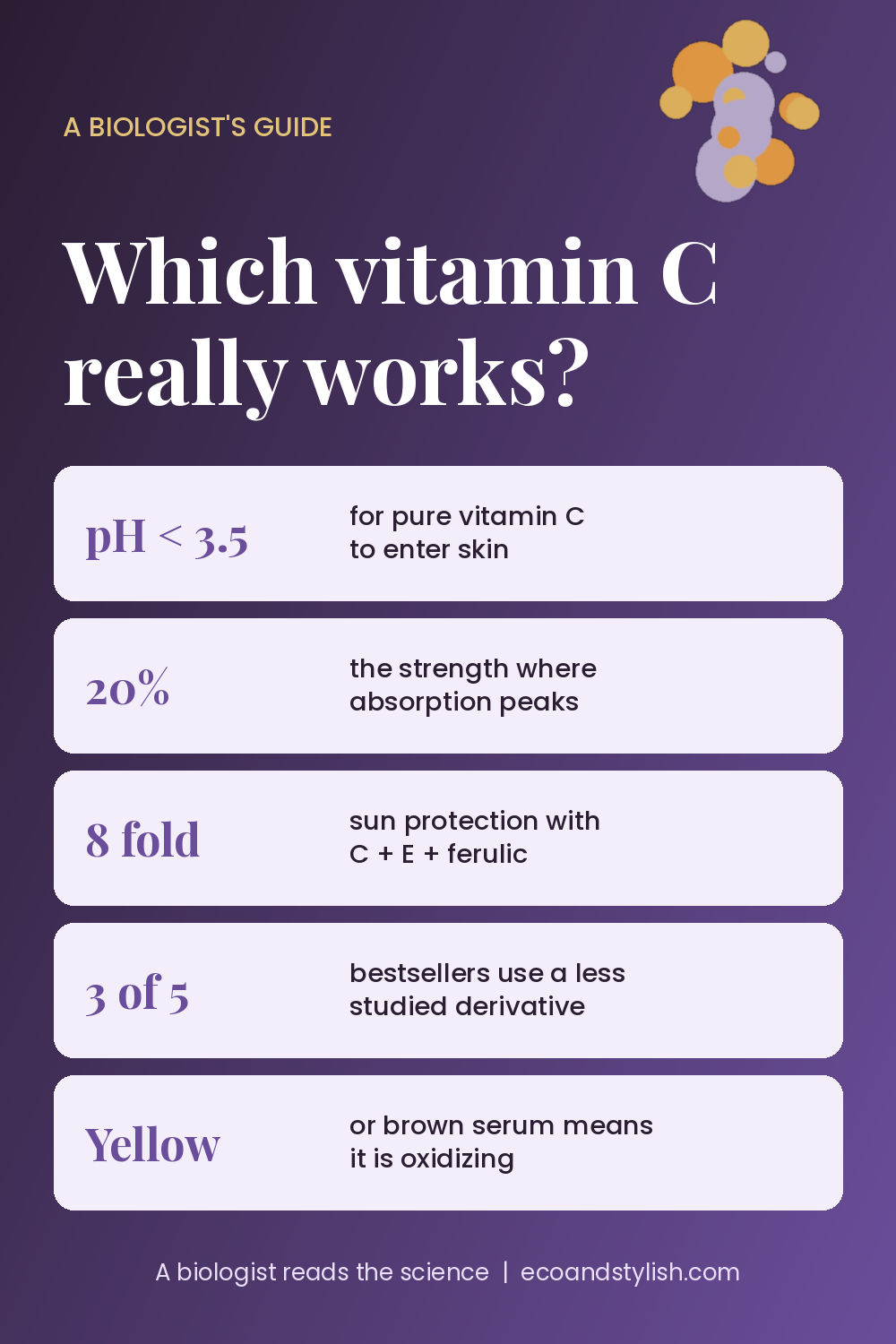
- The pH matters: L ascorbic acid only entered skin when the formula was acidic, below pH 3.5.
- More is not always better: skin levels rose up to a 20% concentration and did not rise further above it.
So 10 to 20% L ascorbic acid at a low pH is the sweet spot. Higher strengths mostly add tingling and irritation.
Case study: why ferulic acid doubled the protection
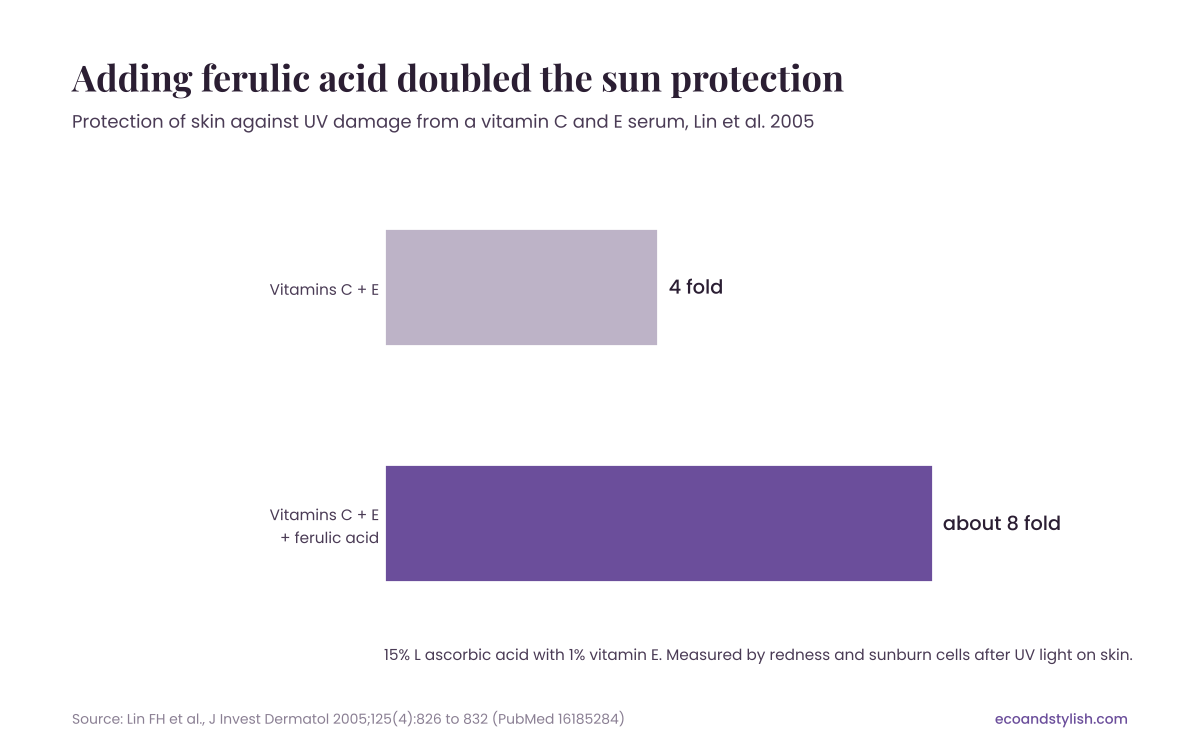
Vitamin C is a team player. In a 2005 study by Lin and colleagues, the same Duke group tested a serum of 15% L ascorbic acid with 1% vitamin E on skin exposed to simulated sunlight. Vitamin C and E together protected the skin about 4 fold against redness and sunburn cells. Adding just 0.5% ferulic acid, an antioxidant found in plant cell walls such as oats and rice bran, roughly doubled that to about 8 fold. Ferulic acid also made the vitamin C more stable in the bottle.
This is the recipe behind SkinCeuticals C E Ferulic, a dermatologist favorite with the same 15%, 1% and 0.5% formula. It is sold mainly through clinics and its own website, so I have not linked it here, but several serums on Amazon follow the same idea at a lower price.
One important point: this is extra protection, not a replacement for sunscreen. Vitamin C does not absorb UV light the way sunscreen does. Use both.
What the human trials found
Most of the hype around vitamin C serum rests on a small number of controlled trials on sun damaged facial skin. They are encouraging, but they are small.
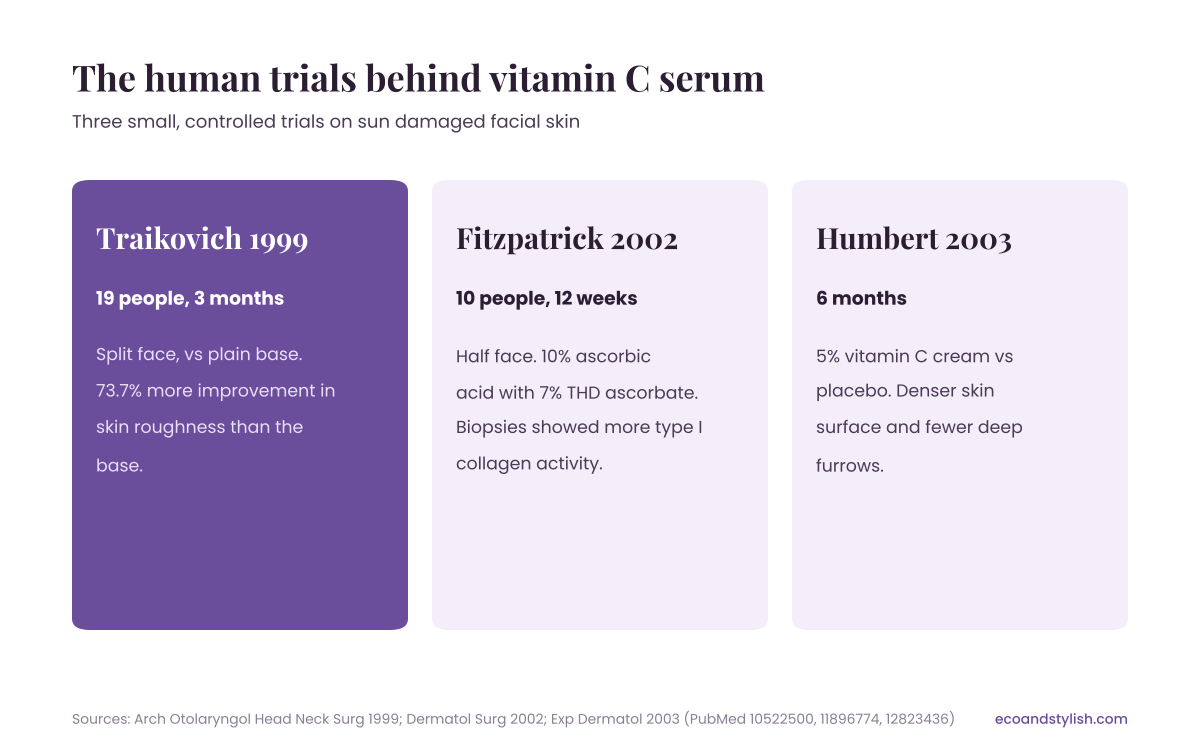
- Traikovich 1999: 19 people used a vitamin C serum on one side of the face and a plain base on the other for 3 months. Skin roughness improved 73.7% more on the vitamin C side.
- Fitzpatrick 2002: 10 people used a serum of 10% ascorbic acid with 7% of a derivative on half the face for 12 weeks. Wrinkles looked better, and skin biopsies showed more activity of type I collagen, the main structural protein of skin.
- Humbert 2003: a 5% vitamin C cream used for 6 months against a placebo cream gave fewer deep furrows and denser skin under the microscope.
A 2017 review by Pullar and colleagues in Nutrients sums it up well: topical vitamin C can improve the look of sun damaged skin, but the formulation decides whether it reaches the skin at all, and derivatives have much less human evidence.
What is really inside popular vitamin C serums
I checked the ingredient information on five of the most popular vitamin C serums on Amazon. Three of the five, including the most reviewed one, use sodium ascorbyl phosphate, a derivative, rather than pure L ascorbic acid.
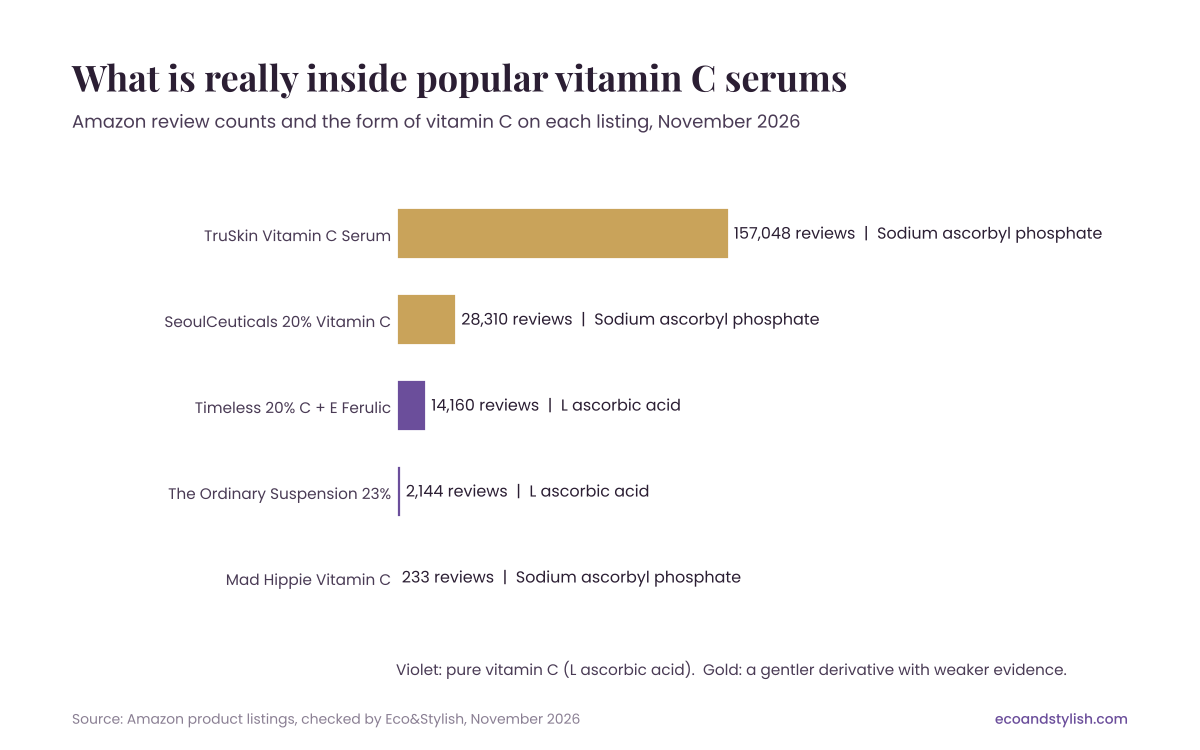
That does not make derivatives useless. Sodium ascorbyl phosphate is stable, gentle and a good choice for sensitive skin. The Pullar review notes that phosphate derivatives can be converted to vitamin C in the body, but slowly, and that they are poorly absorbed through skin. But if you want the form with the strongest evidence, read the label and look for ascorbic acid or L ascorbic acid near the top of the ingredient list.
Best vitamin C serums
I chose these on the form of vitamin C, supporting antioxidants, packaging and long records of buyer reviews.
| Serum | Vitamin C form | Best for |
|---|---|---|
| Timeless 20% C + E + Ferulic | L ascorbic acid | Best overall, aging skin |
| The Ordinary Vitamin C 23% | L ascorbic acid | High strength on a budget |
| TruSkin Vitamin C Serum | Sodium ascorbyl phosphate | Most popular, gentle |
| SeoulCeuticals 20% Vitamin C | Sodium ascorbyl phosphate | Sensitive skin |
| Mad Hippie Vitamin C Serum | Sodium ascorbyl phosphate | Clean ingredient list |
1. Timeless 20% Vitamin C + E + Ferulic Acid Serum
The closest match on Amazon to the formula in the Lin study: L ascorbic acid with vitamin E and ferulic acid, in a dark dropper bottle, with more than 14,000 reviews. At 20% it sits right at the top of the useful range, so start every other day if your skin is sensitive. My pick for aging skin.
2. The Ordinary Vitamin C Suspension 23% + HA Spheres 2%
A water free suspension of pure L ascorbic acid, sold here as a pack of two, with around 2,100 reviews. At 23% it is above the 20% level where absorption stopped rising in the Pinnell study, and the texture is slightly gritty. The brand suggests evening use and mixing it into a cream to build tolerance. Best for skin that already tolerates actives.
3. TruSkin Vitamin C Serum
The most reviewed vitamin C serum on Amazon, with more than 157,000 reviews. It uses sodium ascorbyl phosphate with vitamin E and hyaluronic acid. Gentle and pleasant to use, but less proven than pure vitamin C.
4. SeoulCeuticals 20% Vitamin C Serum
A popular Korean style serum with more than 28,000 reviews, also based on sodium ascorbyl phosphate. A good, gentle choice if pure vitamin C has irritated your skin before.
5. Mad Hippie Vitamin C Serum
A short ingredient list with sodium ascorbyl phosphate, vitamin E and ferulic acid. Only a few hundred reviews on Amazon, but it has a loyal following among people who prefer simple formulas.
How to use vitamin C serum
- Apply 3 to 5 drops in the morning on clean, dry skin, before moisturizer.
- Always follow with sunscreen. Vitamin C boosts protection but does not replace it, so pair it with one of these organic sunscreens.
- Start every other day for the first two weeks, especially with pure L ascorbic acid.
- Store it closed, cool and away from light. If it turns dark yellow or brown, it has oxidized and lost much of its power.
- Give it 8 to 12 weeks before judging results, the length of the trials above.
What should you not mix with vitamin C?
- Benzoyl peroxide: it can oxidize vitamin C, so use them at different times of day.
- Strong acids and retinol at the same time: they can add up to irritation. A simple plan is vitamin C in the morning and retinol at night.
- Niacinamide is fine: the old warning comes from lab tests on pure powders under heat, not from modern skincare. Many people use both without problems.
Vitamin C also pairs well with gentle repair ingredients in the evening, such as copper peptides, if you apply them at different times.
The bottom line
Vitamin C serum is one of the few skincare ingredients with real lab and clinical evidence, but only when the formula lets it reach your skin. Look for 10 to 20% L ascorbic acid, ideally with vitamin E and ferulic acid, in a dark bottle. Choose a derivative if your skin is sensitive, use it every morning under sunscreen, and throw it out when it turns brown.
This article is for education only and is not medical advice. Patch test new products and talk to a dermatologist if you have sensitive skin or a skin condition.
Vitamin C serum FAQ
Which vitamin C serum is best?
Look for 10 to 20% L ascorbic acid in an acidic formula with vitamin E and ferulic acid, in dark, airtight packaging. On Amazon, the Timeless 20% Vitamin C + E + Ferulic Acid Serum is the closest match to the formula tested in the Lin 2005 study.
What vitamin C serums do dermatologists recommend?
Dermatologists often recommend serums based on the vitamin C, vitamin E and ferulic acid formula tested at Duke University, such as SkinCeuticals C E Ferulic. Pure L ascorbic acid at 10 to 20% has the most evidence.
Which vitamin C serum is best for aging skin?
For sun damaged and aging skin, choose L ascorbic acid at 10 to 20% with vitamin E and ferulic acid, and use it daily under sunscreen. Small trials showed better roughness, wrinkles and collagen activity after 3 to 6 months.
Is sodium ascorbyl phosphate as good as vitamin C?
It is more stable and gentler, but it has much less human evidence. In a pig skin study, two common derivatives did not raise vitamin C levels in skin the way L ascorbic acid did.
What should you not mix with vitamin C?
Avoid applying it at the same time as benzoyl peroxide, and be careful layering it with strong acids or retinol, which can irritate. Niacinamide is fine to use with vitamin C.
How do you know if vitamin C serum has gone bad?
If the serum turns dark yellow, orange or brown, the vitamin C has oxidized and lost much of its strength. Keep the bottle closed, cool and out of light.

Erzsebet Frey (Eli Frey) is a biologist and science communicator with Bachelor of Science in Biology, and Master of Science in Ecology from the University of Belgrade. Originally from Serbia, she has lived in Sri Lanka since 2017. Eli has worked internationally in countries like Oman, Brazil, Germany, and Sri Lanka. In 2018, she expanded into SEO and blogging, completing courses from UC Davis and Edinburgh. Eli has founded multiple websites focused on biology, ecology, environmental science, sustainable and simple living, and outdoor activities. She enjoys creating nature and simple living videos on YouTube and participates in speleology, diving, and hiking.