
This post contains affiliate links. As an Amazon Associate I earn from qualifying purchases, at no extra cost to you.
Red light therapy masks can modestly soften fine lines and improve skin texture, according to small controlled trials, but only with regular use over weeks to months. They are not a facelift, the strongest studies used professional light panels rather than home masks, and the label FDA cleared does not mean the FDA proved the mask works. If you buy one, choose a mask that lists its wavelengths, use it consistently, and protect your eyes.
As a biologist, I find the idea behind red light therapy genuinely elegant. Your skin cells contain mitochondria, the tiny power stations of every cell, and inside them sits an enzyme that absorbs red and near infrared light. Give a cell the right light at the right dose, and it may make a little more energy for repair. The question is how much of that biology survives the trip from the lab to a mask on your face.
Do red light therapy masks work?
Partly. The best evidence shows small, gradual improvements in fine lines, skin roughness and collagen density after many sessions. Results are subtle, they take weeks, and they fade if you stop. Masks are also lower powered than the clinic devices used in many studies, so expect a gentle effect rather than a dramatic one.
How red light affects skin cells
The scientific name for red light therapy is photobiomodulation. In a widely cited 2013 review in Seminars in Cutaneous Medicine and Surgery, Avci and colleagues explain the main theory: red and near infrared light are absorbed by cytochrome c oxidase, an enzyme in the mitochondria, which can boost the cell’s energy production and trigger repair signals.
Wavelength decides how deep the light travels. The same review notes that light between 390 and 600 nm is used for surface tissue, while longer wavelengths between 600 and 1,100 nm reach deeper.
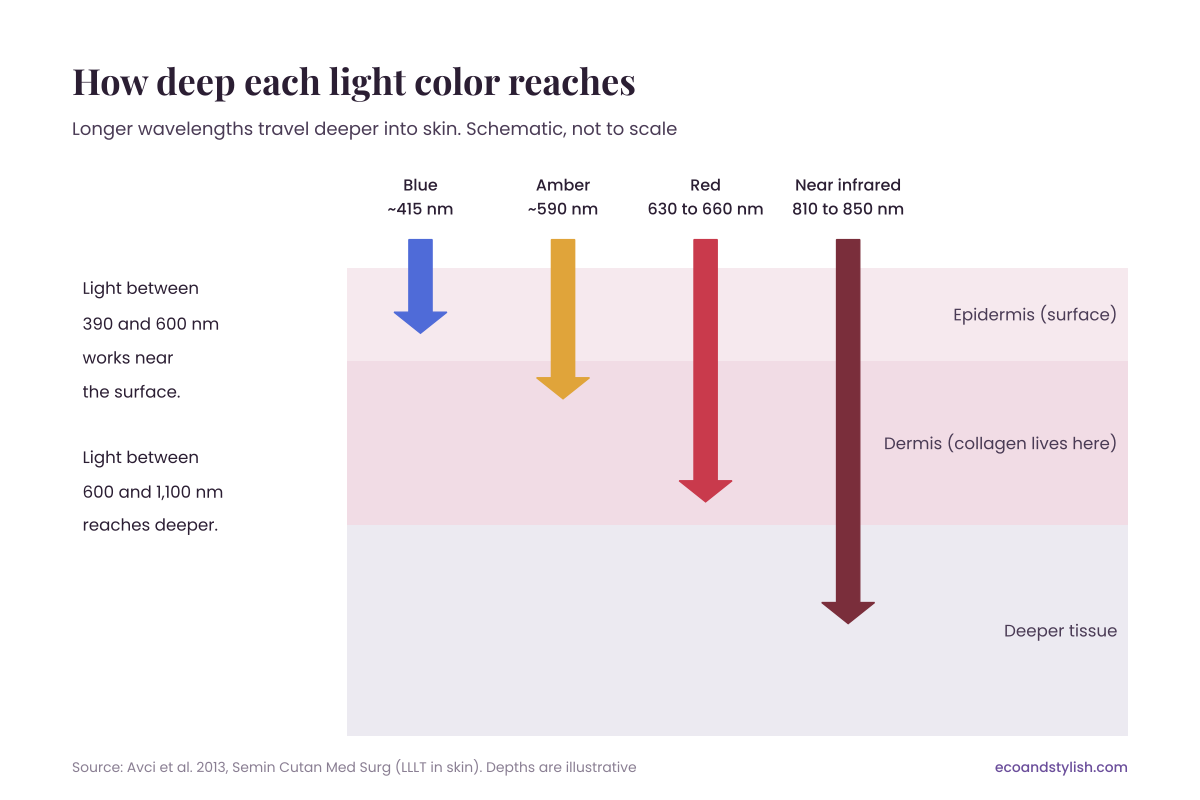
- Blue light, around 415 nm: stays near the surface and is used against acne bacteria.
- Red light, around 630 to 660 nm: reaches the dermis, where collagen is made. This is the main anti aging wavelength.
- Near infrared, around 810 to 850 nm: invisible to us, reaches deeper still, and is often paired with red.
What the clinical trials found
Trial 1: full body light panels. In a 2014 controlled trial by Wunsch and Matuschka, 136 volunteers took part. The 113 treated people received red or broad red to infrared light twice a week for 30 sessions and were compared with 23 untreated controls. The treated groups had significantly better skin roughness, collagen density measured by ultrasound and skin complexion, confirmed by blinded photo assessments. One important detail: the light came from large panels, not face masks.
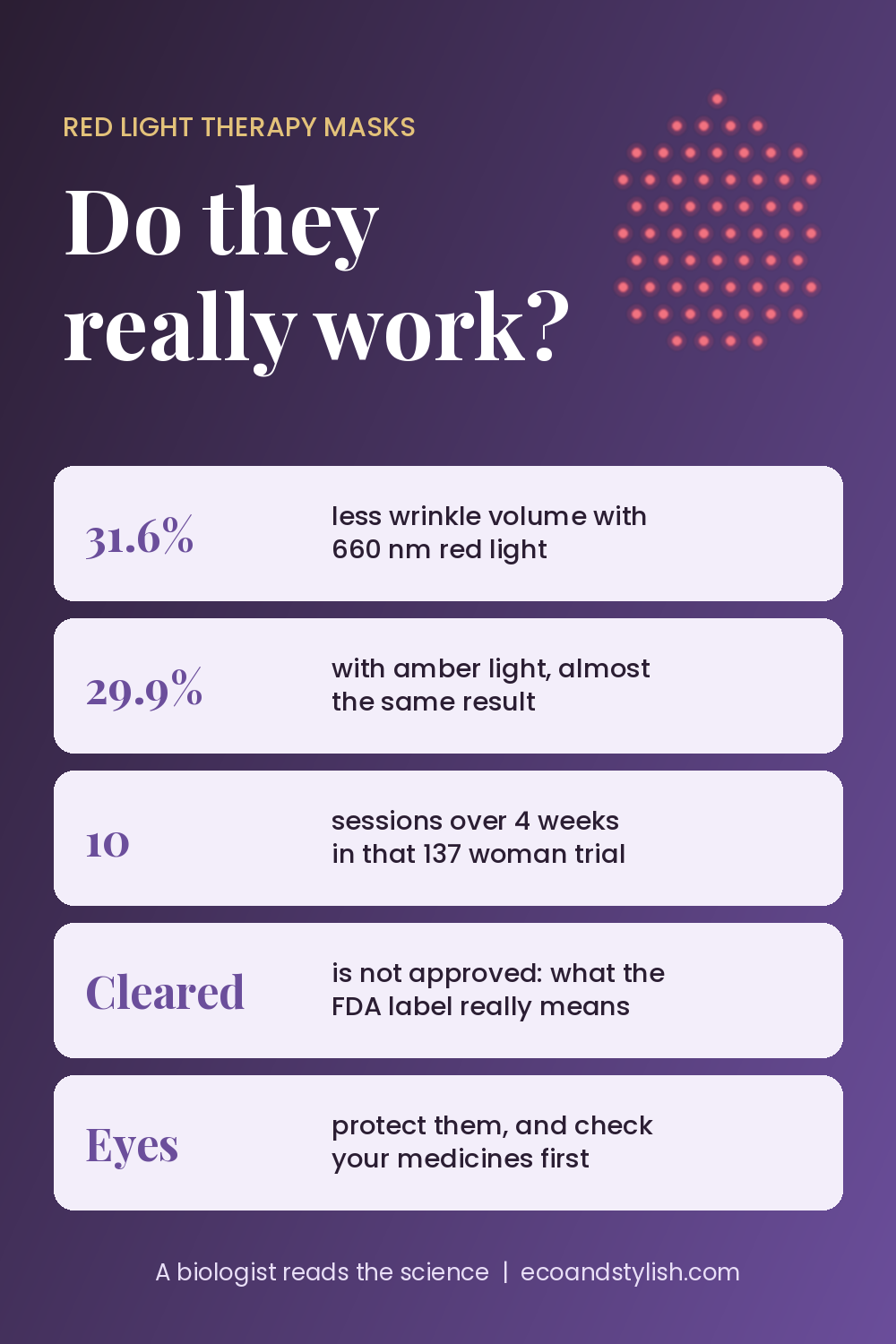
Trial 2: red vs amber light. In a 2023 randomized split face trial by Mota and colleagues, 137 women aged 40 to 65 had red light (660 nm) on one side of the face and amber light (590 nm) on the other, for 10 sessions over 4 weeks.
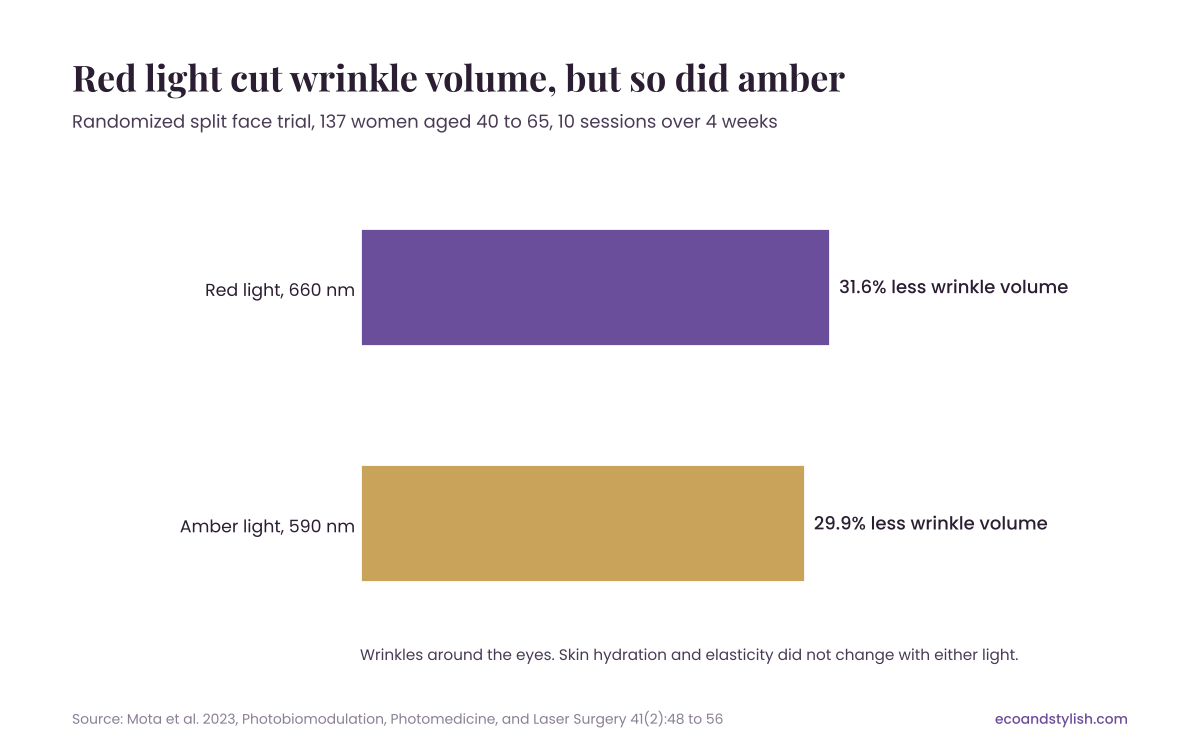
- Red light reduced wrinkle volume around the eyes by 31.6%.
- Amber light reduced it by 29.9%, almost the same.
- Skin hydration and elasticity did not improve with either light.
That twist matters. Red light is not the only color that helped, and the trial had no sham light, so part of the effect could come from regular care and attention. The honest conclusion: light therapy can help, but the size of the effect is modest and the perfect wavelength is still debated.
FDA cleared is not FDA approved
Many masks are sold as FDA cleared. Clearance comes through a route called a 510(k) premarket notification. The maker shows that its device is substantially equivalent to a device already on the market, called the predicate. The FDA then clears it for sale. That is a real safety and quality check, but it is not the same as the FDA proving the mask erases wrinkles.
So treat FDA cleared as a good sign of a properly built device, and judge the results by the trials, not the label.
Eye safety: what you need to know
In 2019, Neutrogena recalled its Light Therapy Acne Mask in the US, and then in the UK and Ireland, citing a theoretical risk of eye injury for people with certain underlying eye conditions and for people taking medicines that make the eyes more sensitive to light. The company stressed that it was safe for the general population when used as directed, but the recall is a good reminder:
- Wear the eye protection that comes with your mask, or keep your eyes closed.
- If you have an eye condition, or take medicines that increase light sensitivity, ask your doctor before you start.
- Never use a mask longer or more often than the instructions say.
How to use a red light therapy mask
- Start on clean, dry skin with no makeup, so the light is not blocked.
- Follow the session time on your device, usually 3 to 10 minutes.
- Be consistent. The trials above used 10 to 30 sessions, from two to several times a week.
- Apply serums after the session. Ingredients like copper peptides pair well with a light therapy routine.
- Keep using sunscreen every morning. A mask cannot undo daily UV damage, so choose one of these organic sunscreens.
- Judge results after 8 to 12 weeks, ideally with photos taken in the same light.
Case study: why everyone searches for these masks in December
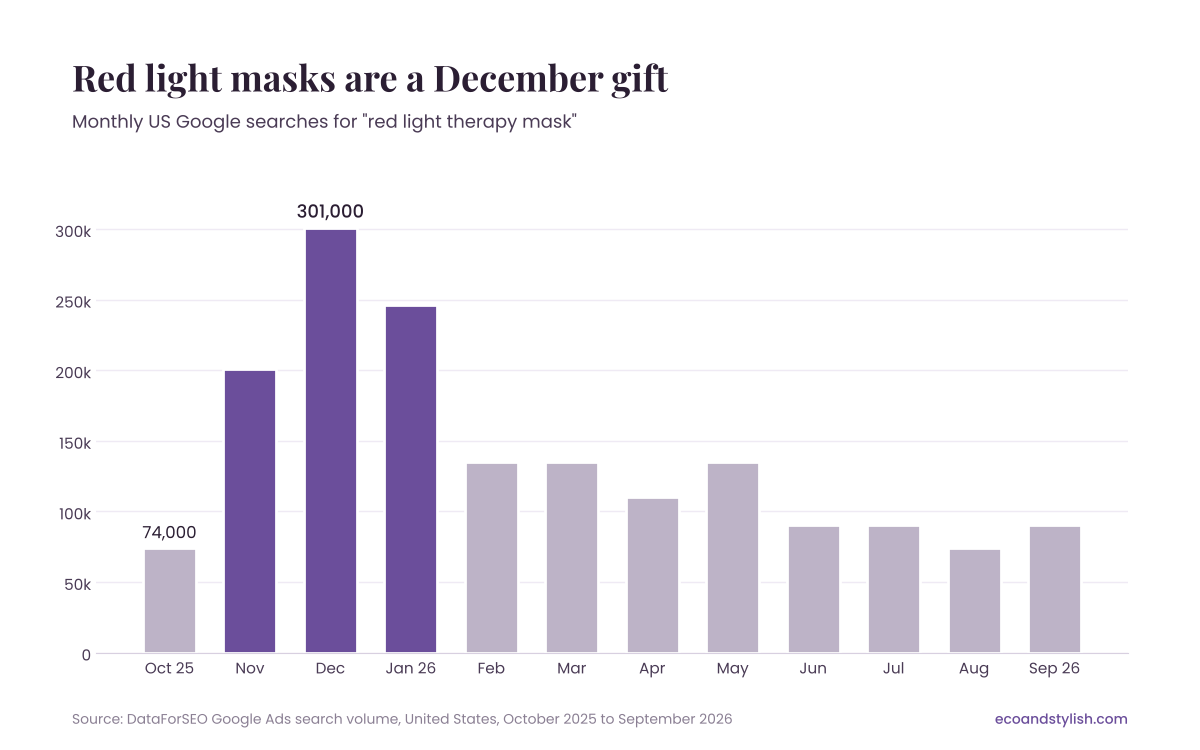
Red light therapy masks are one of the most searched beauty gifts in the US. Searches for red light therapy mask rose from 74,000 in October 2025 to 301,000 in December 2025, four times higher, before settling back near 90,000 a month in 2026.
If you are buying one as a gift this year, look past the holiday marketing and check three things: the wavelengths, the FDA clearance and the return policy.
Best red light therapy masks
I chose these on listed wavelengths, FDA clearance where the listing states it, and buyer reviews. Omnilux, a dermatologist favorite that uses 633 nm red and 830 nm near infrared light, is sold mainly through its own website, so it is not linked here.
| Mask | Light | FDA cleared on listing | Best for |
|---|---|---|---|
| Shark CryoGlow | Red, near infrared, blue | Yes | Best overall |
| CurrentBody Series 3 | Several red and near infrared | Check listing | Premium pick |
| Aphrona Moonlight Pro | Red 630 nm, blue 415 nm, more | Yes | Acne and budget |
| Wireless face and neck mask | 630, 605, 850, 460 nm | Not stated | Neck coverage |
1. Shark CryoGlow LED Face Mask
The most reviewed premium mask on Amazon, with more than 1,100 reviews. The listing says it is clinically tested and FDA cleared, it offers four modes including red, near infrared and blue, and it adds under eye cooling, which feels lovely on tired mornings.
2. CurrentBody LED Light Therapy Face Mask Series 3
The mask beauty editors at Vogue and Forbes rank among the best. It uses several red and near infrared wavelengths and comes with an app that guides your dose. It is new on Amazon with only a few reviews so far, and it is a premium price.
3. Aphrona Moonlight Pro LED Facial Mask
A budget friendly mask listed as FDA cleared, with red light at 630 nm and blue light at 415 nm plus other colors. A good choice if acne is your main concern, with around 580 reviews.
4. Wireless Red Light Therapy Mask for Face and Neck
A cordless mask that covers the neck too, with clearly listed wavelengths of 630, 605, 850 and 460 nm and a 4.6 star average. The listing does not mention FDA clearance, so treat it as a value option.
The bottom line
Red light therapy is real biology, and small trials show modest gains in fine lines, texture and collagen. But the effect is gentle, it needs weeks of consistent use, and the strongest studies used clinic grade light. Choose a mask with clear wavelengths, protect your eyes, keep wearing sunscreen, and enjoy it as one calm ritual in a good skincare routine.
This article is for education only and is not medical advice. Talk to a dermatologist before starting light therapy, especially if you have an eye or skin condition or take medicines that increase light sensitivity.
Red light therapy mask FAQ
Do red light therapy masks really work?
They can modestly improve fine lines, skin roughness and collagen density with regular use over weeks. In a 2023 trial, 660 nm red light reduced wrinkle volume around the eyes by 31.6% after 10 sessions, but amber light did almost as well.
How often should you use a red light therapy mask?
Follow your device instructions. The trials used between 10 and 30 sessions, from about twice a week to several times a week, so consistency over 8 to 12 weeks matters more than long sessions.
Is red light therapy safe for your eyes?
Use the eye protection provided or keep your eyes closed. Neutrogena recalled a light therapy mask in 2019 over a theoretical eye risk for people with certain eye conditions or on light sensitizing medicines, so ask your doctor if that applies to you.
What does FDA cleared mean for an LED mask?
It means the device went through a 510(k) premarket notification and was found substantially equivalent to a device already on the market. It is a safety and quality check, not proof that the mask removes wrinkles.
What wavelength is best for red light therapy?
Most masks use red light around 630 to 660 nm, often with near infrared around 810 to 850 nm, which reaches deeper. Blue light around 415 nm is used for acne.
How long until you see results from red light therapy?
Expect to wait at least 4 to 12 weeks of consistent use. Results are gradual and subtle, so take photos in the same light to compare.

Erzsebet Frey (Eli Frey) is a biologist and science communicator with Bachelor of Science in Biology, and Master of Science in Ecology from the University of Belgrade. Originally from Serbia, she has lived in Sri Lanka since 2017. Eli has worked internationally in countries like Oman, Brazil, Germany, and Sri Lanka. In 2018, she expanded into SEO and blogging, completing courses from UC Davis and Edinburgh. Eli has founded multiple websites focused on biology, ecology, environmental science, sustainable and simple living, and outdoor activities. She enjoys creating nature and simple living videos on YouTube and participates in speleology, diving, and hiking.