

This post contains affiliate links. As an Amazon Associate I earn from qualifying purchases, at no extra cost to you.
Copper peptides are tiny protein fragments that carry copper into your skin, and the best known one, GHK-Cu, is made by your own body. Small human studies suggest copper peptide creams can thicken skin, boost collagen and soften fine lines. But the evidence is thinner than the hype, the proof for hair growth is weak, and the new trend of injecting them is ahead of the science.
I spent three months of a lab internship counting cells under a microscope. It taught me one thing I still carry into every skincare aisle: a result in a dish is a promise, not a proof. So when a serum says copper peptides make skin cells build more collagen, my first question is simple. In a dish, or on a real face?
For this review I went to the source. I read the main studies, counted every copper peptide paper in PubMed myself, and pulled real US search data to see how fast the hype is growing. Here is what the numbers actually say.
What are copper peptides (GHK-Cu)?
A peptide is a short chain of amino acids. GHK is one of the shortest: just three of them, glycine, histidine and lysine. It grabs copper very tightly, and that pairing is called GHK-Cu, or copper tripeptide-1 on an ingredient list.
The chemist Loren Pickart first isolated GHK from human blood plasma in the early 1970s. Your body still makes it today, but less of it every year. According to a 2018 review by Pickart and Margolina, plasma levels sit around 200 ng/mL at age 20 and fall to about 80 ng/mL by age 60. That steady decline is the whole sales pitch: put back what time takes away.
In cell studies, GHK-Cu acts like a repair signal. It nudges skin cells called fibroblasts to make collagen and elastin, and it helps break down damaged collagen so new tissue can replace it. A gene analysis in the same review found that GHK changed the activity of about 31% of human genes by 50% or more. That is a striking number. It is also a number from cell data, not from people.
If you want to read the science yourself, the 2018 GHK-Cu review on PubMed is the most cited summary.
Copper peptides benefits: what the clinical trials found
Here is the honest picture. Most copper peptide skin trials are small, short and often linked to the companies that make the ingredient. Several of the most quoted ones were only ever published as conference abstracts. Still, the results point in the same direction.
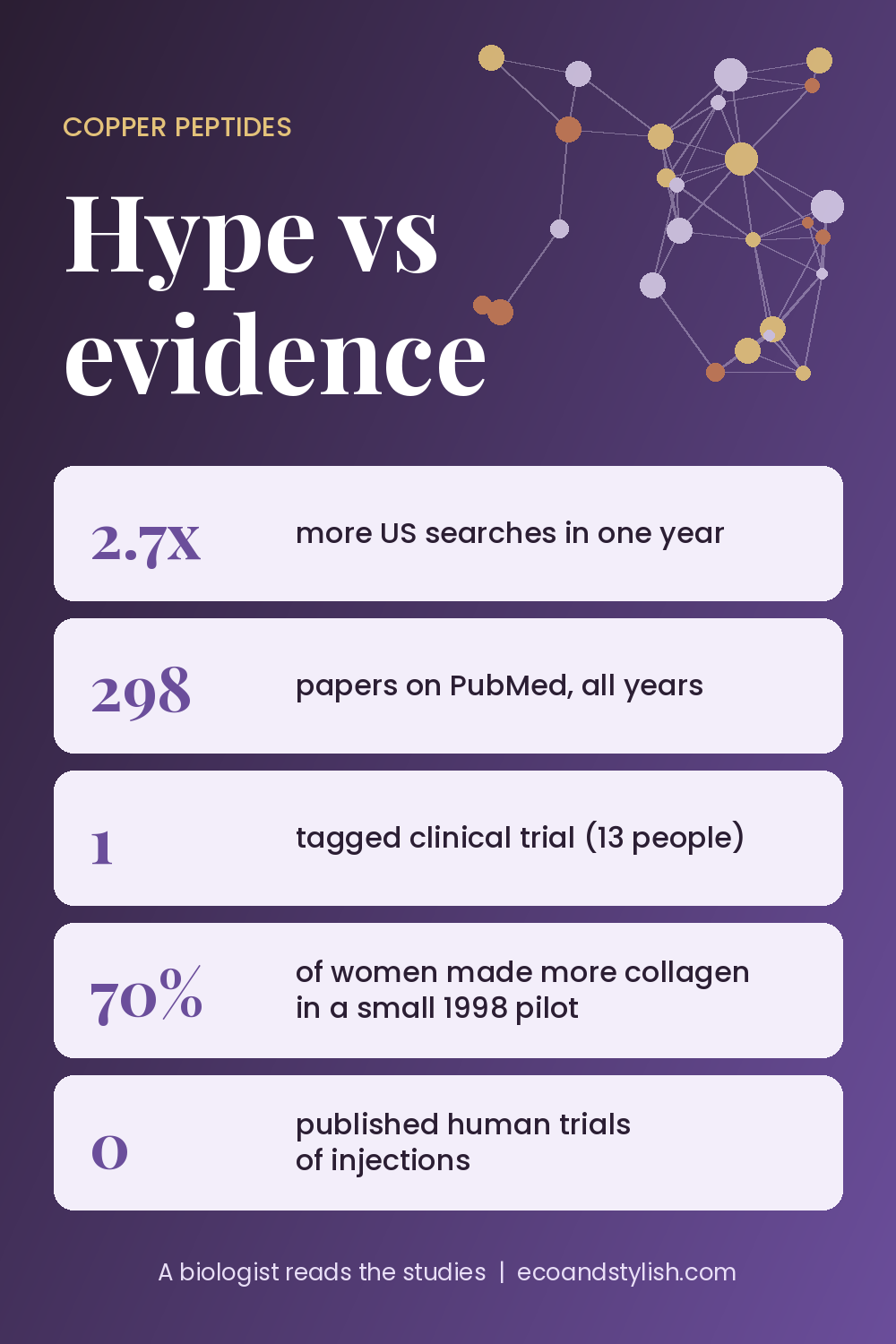
- Collagen: in a small 1998 pilot by Abdulghani and colleagues, a copper peptide cream applied to thigh skin for 12 weeks increased collagen in 70% of the women, compared with 50% for a vitamin C cream and 40% for retinoic acid.
- Fine lines and firmness: in a 12 week study of 71 women with sun damaged skin (Leyden 2002), a copper peptide face cream improved skin density, thickness, laxity and the depth of fine lines.
- Eye area: a copper peptide eye cream tested on 41 women for 12 weeks did better than both a placebo and a vitamin K cream.
- Wrinkle volume: in a 2016 trial of 40 women aged 40 to 65 (Badenhorst and colleagues), a copper peptide serum used twice a day for 8 weeks cut wrinkle volume 55.8% more than the plain serum and 31.6% more than the well known peptide Matrixyl 3000.
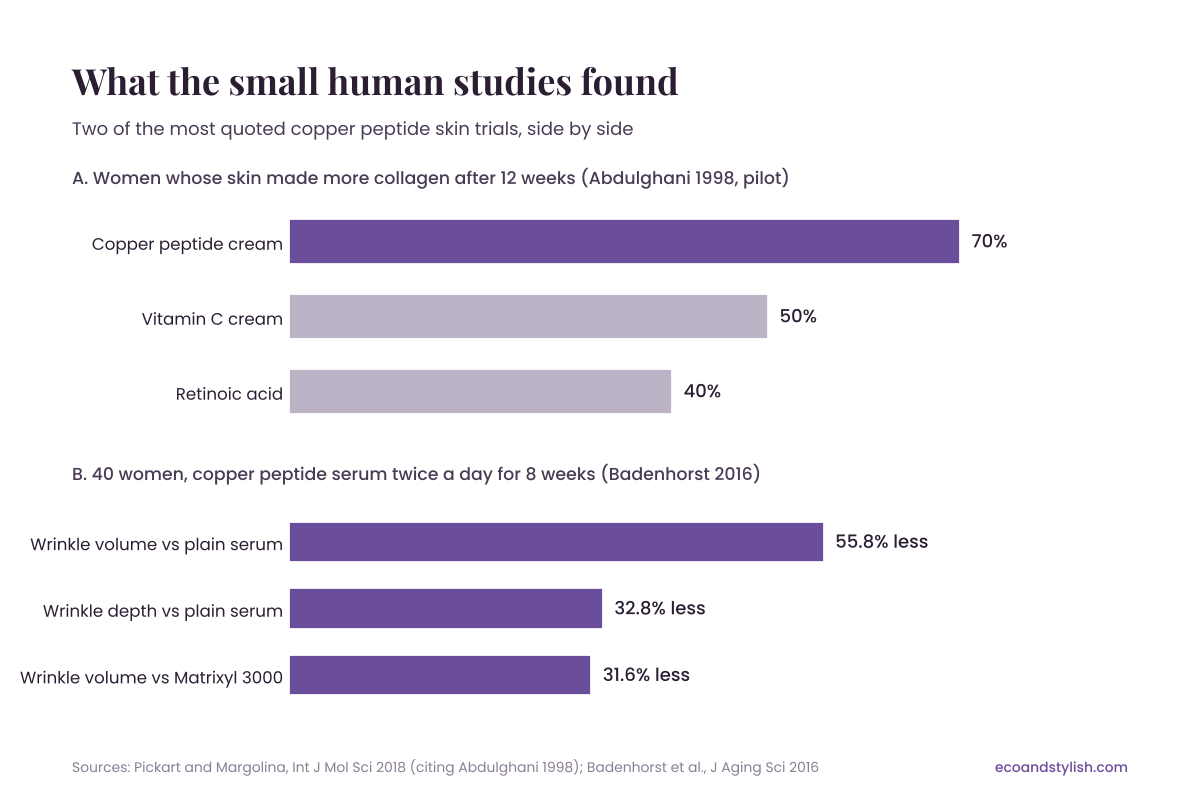
Notice what is missing: large, independent, long term trials. The signal is real enough to take seriously. It is not strong enough to call copper peptides proven the way retinoids are proven.
Case study: copper peptides hype vs evidence in numbers
To see the gap between what people believe and what is known, I measured both sides. The first number is curiosity. The second is science.
1. Searches almost tripled in one year
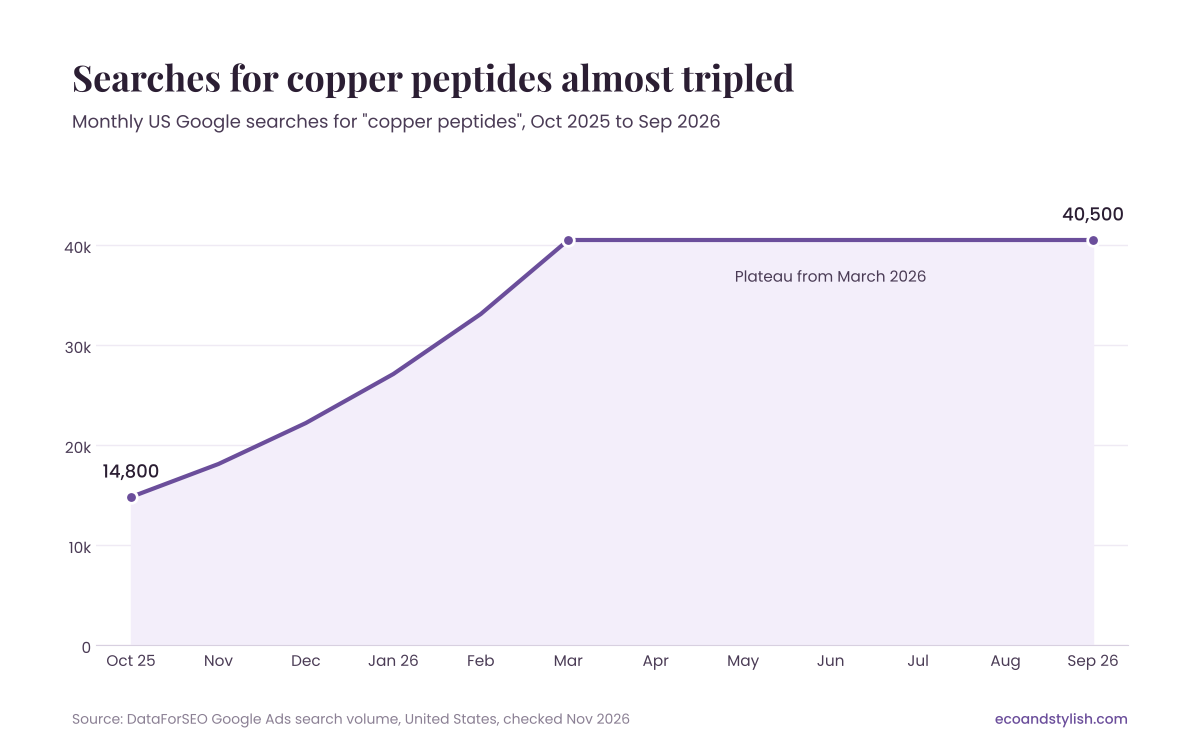
In October 2025, Americans searched for copper peptides about 14,800 times a month. By March 2026 it was 40,500, and it has held there since. Search interest grew 2.7 times in under a year.
2. Research is growing, but from a tiny base
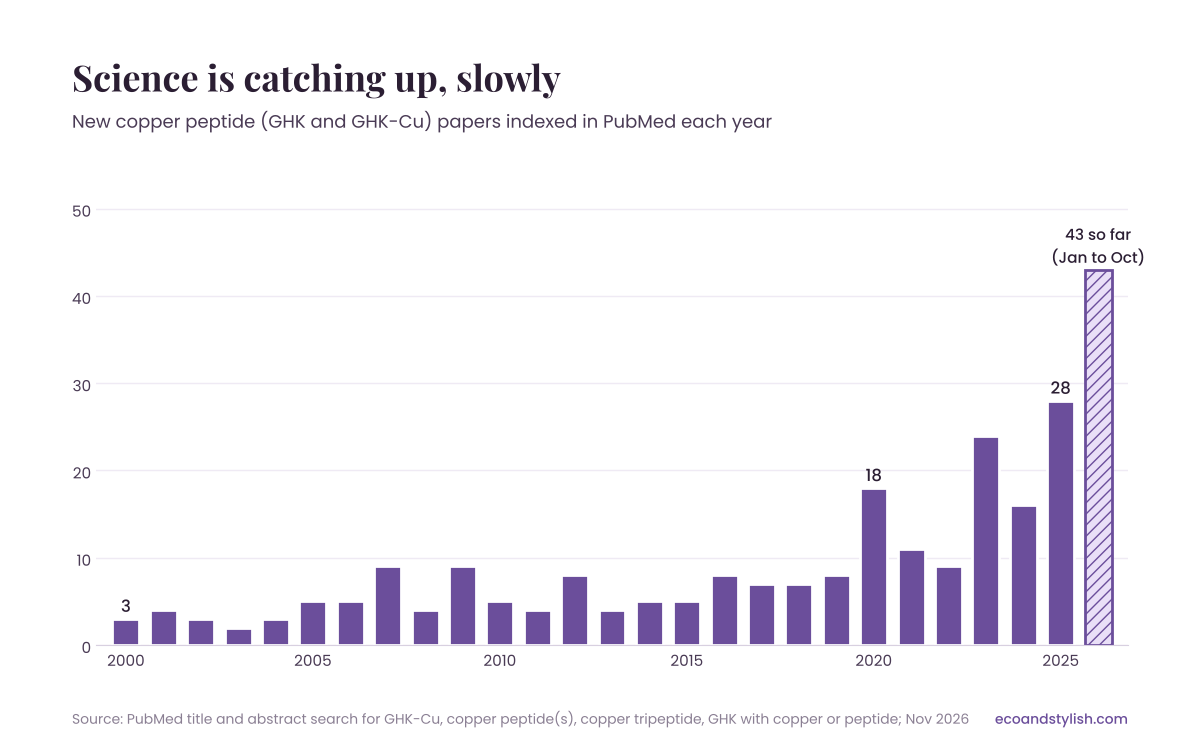
I searched PubMed, the US National Library of Medicine database, for every paper that names GHK-Cu, copper peptides or copper tripeptide. I found 298 papers across all years. In 2015 there were 5 new ones. In 2025 there were 28, and 2026 had already passed 40 by the end of October.
3. Very few are real human trials
This is the twist. Of those 298 papers, 83 are about skin and only 16 even mention hair. Just one is tagged in PubMed as a clinical trial. It was a 2006 study by Miller and colleagues in 13 laser treated patients, and it found no clear difference in redness between the copper peptide group and the control group. Most of the famous trials above never made it into PubMed at all.
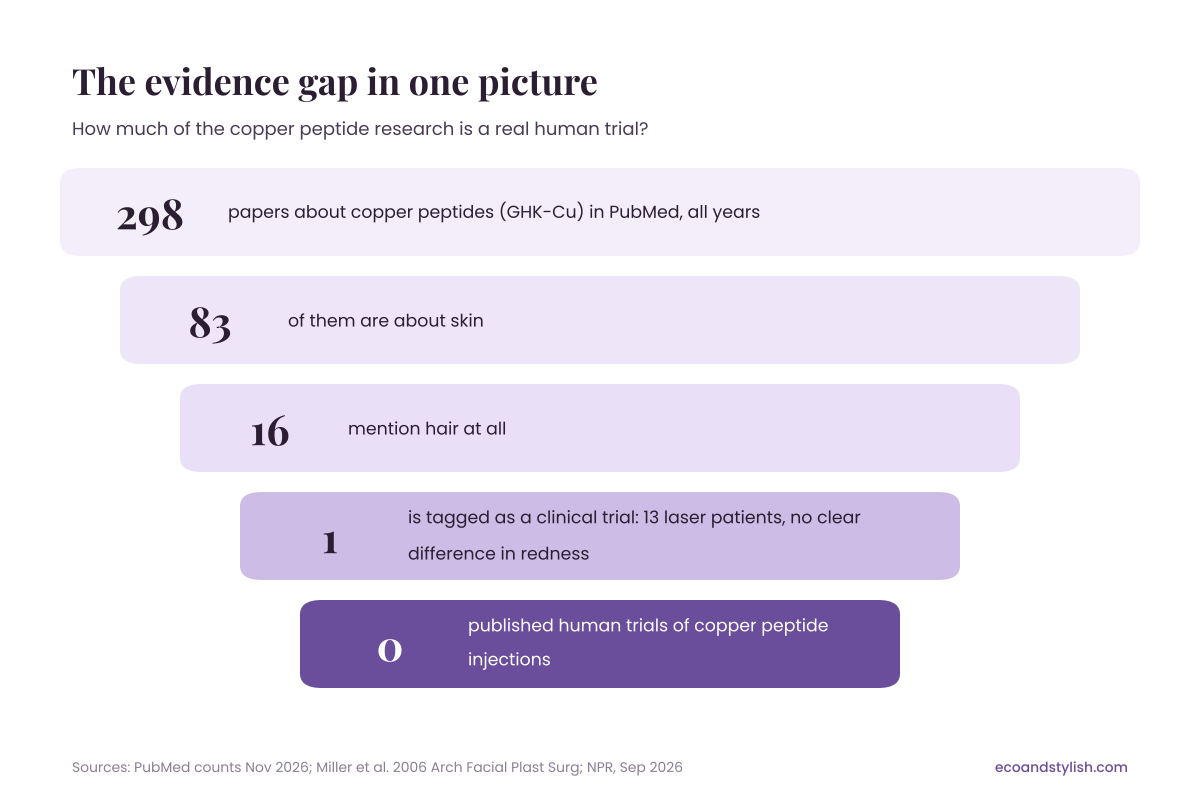
So what does this mean for you? Searches grew far faster than the evidence. Copper peptides are a promising, gentle ingredient with real lab science behind them. They are not a miracle, and anyone who sells them as one is ahead of the data.
Do copper peptides work for hair growth?
This is where I have to be the most honest. Copper peptides for hair growth is a huge search, and the shelves are full of copper hair serums. But no controlled human trial has shown that a topical copper peptide on its own grows more hair.
The lab case is plausible. In cell and animal studies, GHK-Cu enlarged hair follicles and supported the cells around them. The only recent human result I could find, a 2025 report by Kuceki and colleagues, treated just 7 men with a mix of minoxidil, dutasteride and copper peptides pushed into the scalp. They saw a median of 26.5% regrowth, but with two proven hair loss drugs in the same mix, there is no way to tell what the copper did.
If you are losing hair, start with a dermatologist and the treatments that have strong human trials. A copper peptide scalp serum is a gentle extra at best, not a first line fix.
Copper peptides side effects and what not to mix
On the skin, copper peptides are among the gentler active ingredients. They have been used in cosmetics for decades, and serious reactions from creams are rare. Mild side effects can still happen:
- tingling, redness or irritation, especially on sensitive skin or at high strengths
- breakouts in some people, usually from the rest of the formula
- a faint blue or green tint, which is simply the copper
- allergic reactions, which are rare but possible with any product
Patch test first. Apply a little behind your ear or on your inner arm for a few days before using it on your face.
What not to mix with copper peptides
- Strong acids (AHA and BHA): very low pH can loosen the copper from the peptide. Use exfoliating acids on different nights.
- Pure vitamin C (L ascorbic acid): it is both acidic and a strong reducing agent, so the classic advice is to keep it apart. Use vitamin C in the morning and copper peptides at night.
- Retinoids: brands like The Ordinary advise against layering them. Alternate nights instead.
To be clear, these mixing rules come from chemistry and brand guidance, not from human trials that tested the combinations. Separating them costs you nothing, so it is the safe choice.
Copper peptides vs retinol
People often ask which one to choose. The short answer: retinoids have far stronger evidence, while copper peptides are gentler.
| Copper peptides | Retinol and retinoids | |
|---|---|---|
| How they work | Repair signal for collagen, elastin and wound healing | Speed up cell turnover and collagen building |
| Strength of evidence | Small trials, mostly industry linked | Decades of large trials; tretinoin is FDA approved for sun damaged skin |
| Irritation | Low | Common at first: dryness, peeling, redness |
| Pregnancy | Ask your doctor | Prescription retinoids are avoided in pregnancy |
| Best for | Sensitive skin, recovery, beginners | Proven wrinkle and texture results |
You can use both. Put retinol on some nights and copper peptides on the others, and give your skin a few weeks to adjust.
Copper peptide injections: why the trend is ahead of the science
In 2026 the copper peptide trend jumped from creams to needles. As NPR reported in September 2026, GHK-Cu is not an FDA approved drug, and there are no published human studies showing injected copper peptides are safe or effective.
Clinicians interviewed in that report described people with high liver enzymes and copper levels after injecting too much without lab checks. An FDA advisory panel is set to review GHK-Cu for injectable use. Until then, products sold online for injection come with no guarantee of dose, purity or even what is inside. My view as a biologist: keep copper peptides on the surface of your skin.
How to use copper peptides
- Start slow: once a day for the first two weeks, then morning and night if your skin is happy. Most brands suggest twice daily.
- Apply to clean skin: a few drops after cleansing and toner, before heavier creams.
- Seal it in: follow with a simple moisturizer. Here are my picks for the best organic face moisturizers.
- Protect it by day: any collagen you build is undone by sun damage, so finish your morning routine with one of the best organic sunscreens.
- Be patient: the trials ran 8 to 12 weeks. Judge your results at three months, not three days.
Best copper peptide serums on Amazon
I chose these on ingredient lists, copper peptide content and a long record of buyer reviews. None of them is magic. All of them are sensible ways to try the ingredient.
1. The Ordinary Multi-Peptide + Copper Peptides 1%
The best known copper peptide serum and the easiest place to start. It pairs 1% copper peptides with several other peptides and hyaluronic acid. It has thousands of Amazon reviews and a 4.6 star average. The brand itself says to keep it away from strong acids and retinoids, which matches the mixing rules above.
2. COSRX The Blue Copper Peptide Bakuchiol Plump Glow Serum
A gentle pick for sensitive skin. It combines 0.5% copper peptide with 0.25% bakuchiol, a plant based ingredient often used as a softer alternative to retinol. A good choice if retinol has irritated you before.
3. Dr. Brenner Copper Peptide Serum with 1% GHK-Cu
This one is interesting for science fans. It contains 1% GHK-Cu plus Matrixyl 3000, the same peptide copper was compared against in the 2016 wrinkle trial, along with Argireline. A richer formula for mature skin.
4. Asterwood Copper Peptides Serum
A budget friendly serum that pairs GHK-Cu with hyaluronic acid for hydration. Simple formula, more than 1,400 reviews, and an easy way to test whether copper peptides suit your skin before spending more.
The bottom line
Copper peptides are a real molecule with a real story. Your body makes GHK-Cu, it fades as you age, and small human studies suggest putting it back on your skin can build collagen and soften fine lines. That is a beautiful piece of biology. But the hype has outrun the evidence, especially for hair growth and injections. Use a good serum, protect it with sunscreen, give it three months, and keep your expectations as calm as the science.
This article is for education only and is not medical advice. Talk to a dermatologist before starting new treatments, especially if you are pregnant or have a skin condition.
Copper peptides FAQ
Why take copper peptides?
People use copper peptides to support collagen, firmness and skin repair. GHK-Cu is made by your own body and declines with age. Small human studies found copper peptide creams improved skin thickness, collagen and fine lines over 8 to 12 weeks.
Can I take vitamin C while on GHK-Cu?
Yes, but keep them apart. Pure vitamin C (L ascorbic acid) is acidic and can loosen copper from the peptide. A simple routine is vitamin C in the morning and copper peptides at night.
What should you not mix with copper peptides?
Avoid layering copper peptides with strong exfoliating acids (AHA and BHA), pure vitamin C and retinoids in the same routine. Use them at different times of day or on alternate nights.
How often should I use copper peptides on my face?
Start once a day for about two weeks. If your skin tolerates it, most brands suggest morning and night. The studies that showed results ran for 8 to 12 weeks.
What are the downsides of using copper peptides?
The main downsides are mild irritation in some people, the risk of mixing them with the wrong actives, and limited large scale evidence. Injected copper peptides carry more serious risks and are not FDA approved.
What cancels out copper peptides?
Strong acids and pure vitamin C are thought to weaken copper peptides by changing the copper in the complex. This comes from chemistry rather than human trials, so the safe choice is to use them separately.

Erzsebet Frey (Eli Frey) is a biologist and science communicator with Bachelor of Science in Biology, and Master of Science in Ecology from the University of Belgrade. Originally from Serbia, she has lived in Sri Lanka since 2017. Eli has worked internationally in countries like Oman, Brazil, Germany, and Sri Lanka. In 2018, she expanded into SEO and blogging, completing courses from UC Davis and Edinburgh. Eli has founded multiple websites focused on biology, ecology, environmental science, sustainable and simple living, and outdoor activities. She enjoys creating nature and simple living videos on YouTube and participates in speleology, diving, and hiking.